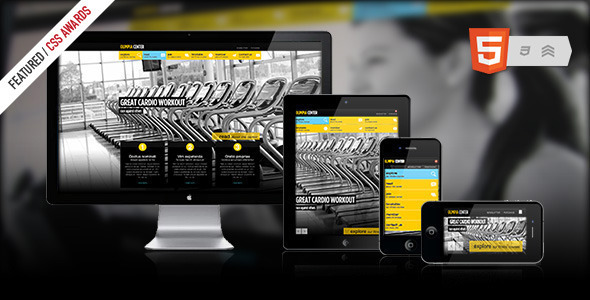
Olimpia Responsive Fullscreen Fitness Center is a static HTML5 and CSS3 website template sold on ThemeForest for $21, aimed at gyms, personal trainers, yoga studios and wellness businesses that want a single-page, image-led web presence. It is built by Ansonika, a developer with a long catalogue of health and beauty templates, and it has been purchased 315 times. The template is not a WordPress theme: it is a plain HTML package that a developer edits by hand, which is the single most important fact for anyone deciding whether it fits their project.
The product sits in the ThemeForest health-beauty category and carries the vendor’s own tags of clean, fitness, fitness center, fullscreen, modern, responsive and sport. Those tags describe the design intent accurately. The layout leans on large background photography, a fullscreen slider and a dark, high-contrast palette that suits gym and studio branding better than a generic corporate theme would.
What the Olimpia Responsive Fullscreen Fitness Center template actually includes
The defining feature is the fullscreen presentation. Sections stretch to fill the browser viewport, and the Flexslider component rotates large images behind or above the content. For a fitness business, where atmosphere and photography do most of the selling, this matters more than a long feature list. A visitor landing on the page sees the facility before reading a single word about membership pricing.
Around that core, the template ships with a set of interactive components that cover the usual needs of a small business site:
- Responsive layout built on the Skeleton grid, which means the columns reflow from desktop down to tablets and phones. The vendor explicitly invites buyers to resize their browser window to test it, which is a reasonable confidence signal about the breakpoints.
- Fullscreen gallery and Prettyphoto lightbox viewer, so studio photos, class images or transformation shots can be browsed without leaving the page.
- Three AJAX PHP forms — a newsletter signup, a join or membership enquiry form, and a contact form. AJAX here means the form submits without a full page reload, which keeps the visitor in place. These require a PHP-capable server to function.
- Accordion tabs and standard tabs, useful for compressing class schedules, trainer bios or FAQ content into a small footprint.
- Google Maps embed for the physical location, which is close to essential for any business with a walk-in address.
- Responsive video support, so embedded video scales with the layout rather than overflowing on mobile.
- CSS3 @font-face typography, giving control over the typeface without relying on a third-party font service.
The markup is described as valid HTML5 and CSS3. The vendor does not state whether the CSS is preprocessed with Sass or Less, so anyone expecting a build pipeline should verify that before purchase. The listing also notes that the demo images are not included — they come from stock libraries and Flickr — so a buyer must supply their own photography or license replacements.
Where this template fits, and where it does not
The strongest fit is a single-location gym, CrossFit box, dance studio, physiotherapy clinic or personal training business that already has good photography and needs a brochure site rather than a content platform. A freelance developer building a site for a local fitness client can deliver something visually substantial in a short timeframe, because the layout decisions are already made.
It also suits agencies producing a batch of small health and beauty sites where speed of delivery matters more than a bespoke design system. The component set — slider, gallery, tabs, forms, map — covers the majority of what these businesses ask for.
The wrong choice is equally clear. A business that wants to publish blog posts weekly, manage class bookings, sell memberships or run an online store should not start here. There is no content management system, so every text change means editing HTML and re-uploading files. A gym owner without developer support would be dependent on someone else for something as simple as changing a price. Anyone needing a booking engine, member portal or e-commerce checkout should look at a WordPress fitness theme or a dedicated studio management platform instead.
A second mismatch is a multi-location chain. The template is structured around one facility, one map and one contact route. Scaling it to several branches means either duplicating the site or rebuilding the navigation, at which point the time saving disappears.
Setting up the Olimpia Responsive Fullscreen Fitness Center template
Installation is a file upload, not a guided wizard. The buyer downloads a ZIP from ThemeForest, unzips it locally and edits the HTML files in a code editor. There is no admin panel, no database and no installer script. The practical prerequisites are a code editor, an FTP client or hosting file manager, and a server that runs PHP if the AJAX forms are to work.
The realistic work breaks down into four stages. First, replacing the demo images with licensed photography sized for fullscreen display — this is usually the longest step, because fullscreen sliders demand large, high-quality files and the template ships without any. Second, editing the text content directly in the markup: headings, service descriptions, trainer profiles and pricing. Third, wiring the three forms to a working email address and testing that submissions actually arrive, since PHP mail configuration varies by host. Fourth, swapping the Google Maps embed for the correct address.
For a developer comfortable with HTML and CSS, the whole process is realistically a day or two for a straightforward site, plus whatever time the client takes to supply images and copy. For someone with no coding background, the template is not self-service, and the vendor does not advertise a page builder or visual editor. The last update recorded on the listing is September 2021, so buyers should expect the codebase to reflect that era rather than current tooling.
Strengths and limitations of the Olimpia Responsive Fullscreen Fitness Center template
Strengths
- The fullscreen, photography-first layout is genuinely well matched to fitness and wellness branding, where visual atmosphere drives enquiries.
- Responsive behaviour is a stated design goal rather than an afterthought, and the Skeleton grid is a well-understood foundation.
- Three working AJAX forms cover newsletter capture, membership enquiries and general contact without a third-party plugin.
- At $21 it is a low-cost starting point, and 315 sales with a health-beauty category placement suggests it has been tested in the wild.
- The component set — slider, gallery, lightbox, tabs, accordion, map, video — removes most of the routine build work.
Limitations
- There is no CMS. Every content change requires editing HTML files, which rules out non-technical owners maintaining the site themselves.
- Demo images are not included and must be licensed separately, which adds cost and time that the $21 price does not reflect.
- The AJAX forms depend on PHP and on the host’s mail configuration; the vendor does not document a fallback for hosts where PHP mail is restricted.
- The most recent vendor update is from September 2021. There is no published roadmap, and the listing does not state compatibility with current PHP versions.
- No booking, membership management or e-commerce functionality is included, and none is implied.
- The design is built around a single location, so multi-branch businesses will need structural changes.
How it compares with the wider category
The realistic alternative for most buyers is a WordPress fitness theme. Those cost more, typically in the $40 to $70 range, but they come with a visual editor, a plugin ecosystem and the ability for a client to update content without touching code. For a business that intends to publish news, run a blog or change offers regularly, that difference outweighs the price gap.
A second alternative is a general-purpose HTML template, which may be cheaper but will not carry the fitness-specific visual language. The value here is the combination of fullscreen treatment and health-beauty styling that would otherwise take a designer time to construct.
A third option is a purpose-built studio management platform with a website attached. Those handle bookings, payments and member records, but they usually lock the business into a subscription and constrain the design. Olimpia sits at the opposite end: full design control, no recurring cost, no operational features.
The honest positioning is that this is a presentation layer, not a business system. Judged as a presentation layer for a single fitness location, it does its job at a fair price. Judged as a website platform, it is deliberately minimal.
Frequently Asked Questions
Is Olimpia Responsive Fullscreen Fitness Center a WordPress theme?
No. It is a static HTML5 and CSS3 template, not a WordPress theme. There is no admin dashboard, no database and no plugin support. Content is edited directly in the HTML files and uploaded to the server. Buyers who want to manage content through a WordPress dashboard should choose a WordPress fitness theme instead.
Do I need coding skills to use this template?
Yes, basic HTML and CSS knowledge is effectively required. Replacing text, images, the map embed and the form recipient address all happen in the source files. The vendor markets the template as easy to edit, but that assumes familiarity with code. A non-technical gym owner would need to hire a developer for both setup and ongoing changes.
Are the images shown in the demo included with the purchase?
No. The listing states plainly that images are not included. The demo photography comes from stock libraries and Flickr, and each image would need its own licence for commercial use. Buyers should budget separately for photography, and fullscreen sliders need large, high-resolution files, which tends to cost more than standard web images.
Do the contact and newsletter forms work out of the box?
They work on a PHP-capable server once the recipient email address is configured, but they are not plug-and-play. The three AJAX forms submit without a page reload, which requires PHP on the host. Some shared hosts restrict PHP mail, so the forms should be tested after upload. The vendor does not document a fallback for restricted environments.
Verdict
Olimpia Responsive Fullscreen Fitness Center is a sensible purchase for a developer or agency building a single-location gym, studio or wellness site where strong photography and a fullscreen layout matter more than content management. At $21 with 315 sales behind it, the risk is low and the time saving is real. It is the wrong purchase for a business that needs to update its own content, take bookings, sell memberships or run multiple locations, because none of that is built in and the template has not been updated since 2021. Buy it as a design foundation with a developer attached, not as a complete website solution.