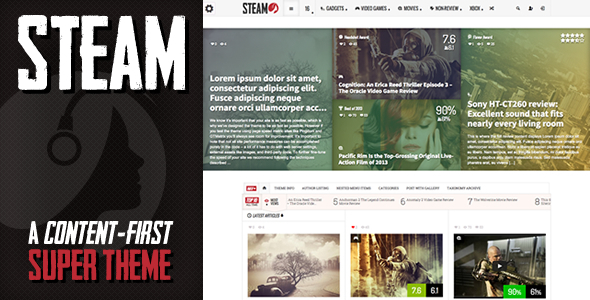
Steam is a WordPress theme built for review-driven publications that mix long-form criticism with magazine-style browsing. It ships with a full rating system, a “minisite” structure for running several content verticals under one installation, and a set of AJAX carousels designed to surface the most-read, best-rated or most-discussed articles. Anyone planning a Steam blog-magazine around film, music, games, technology or entertainment coverage should weigh it against a modern block-based theme before buying, because the last vendor update landed in August 2018.
What the Steam theme actually does well
The centrepiece is the review engine. Editors can score an item with stars, numbers, percentages or letter grades, and those scores can be weighted across several criteria rather than collapsed into a single figure. Both editor and reader ratings are supported, together or separately, and every review can be ranked against the rest by either metric. Reader scores update live over AJAX, so a visitor submitting a score in the comments sees the total shift without a page reload. For a reviews site, that is the difference between a theme that merely displays a number and one that treats scoring as a first-class content type.
Steam also implements Google rich snippet and schema.org markup for reviews. In practice this means review pages are structured so search engines can pull star ratings into results listings, which matters more for a review publication than almost any visual feature.
The minisite concept is the second distinctive piece. A single WordPress install can host several separate sections — film, music, technology, whatever the editorial plan requires — each with its own taxonomy, menus, sidebars and page layout. The one-click minisite builder and the mega menu that dynamically pulls posts from chosen minisites, categories or tags make this manageable without touching template files. Sites that would otherwise run a WordPress multisite network can consolidate into one dashboard.
Around that core sits a large library of discovery components. The Top Ten carousel ranks posts by different metrics over a chosen time window. The Trending carousel filters by AJAX controls. The Sizzlin’ carousel rotates hand-picked articles, and the Featured carousel uses Slider Revolution with three predefined layouts and support for embedded video. A separate widget set covers latest articles, top-reviewed items, social counts, tabbed sections and a bar-graph trending display. Sorting controls on archive pages let readers reorder the post loop by most viewed, most liked, most commented, highest editor rating or highest user rating.
Under the hood, the theme is built on Bootstrap 2.3 and validated HTML5, responsive from a 1140px widescreen layout down to mobile, and HiDPI/Retina ready. CSS and JavaScript are combined and minified, and icon fonts are used instead of image sprites, both of which help page weight. The vendor states the theme imports WordPress’s internal jQuery and jQuery UI libraries rather than bundling its own copies, which reduces conflicts with third-party plugins. WooCommerce 2.0+ and BuddyPress 1.7+ are both listed as compatible, so a shop or a community layer can be bolted on.
Where Steam fits, and where it does not
Steam suits an editorial team publishing scored reviews at volume across more than one subject area. A film and television site that also covers soundtracks, or a technology publication with distinct hardware and software desks, gets the most from the minisite architecture. Freelancers building a client site that needs a review section with genuine weighting and reader voting will find the rating system more capable than what most general-purpose magazine themes offer.
It is a poor fit for a simple personal blog. The minisite layer, the carousel stack and the review schema add configuration surface that a single-author site will never use, and the theme’s visual language is dense and promotional rather than minimal. It is also the wrong choice for anyone who needs to build with the WordPress block editor, full site editing or PHP 8-era tooling, because the last vendor update was in 2018 and the theme predates those systems. A project with a hard requirement for current WordPress compatibility testing should look elsewhere.
Setting Steam up in practice
The vendor provides a complete demo site with three-step install instructions, and the theme options include an importer and exporter tool, so a working replica of the demo can be reached quickly — realistically under an hour for the base install. From there, the work is editorial configuration rather than development.
Prerequisites are modest: a WordPress installation, the theme package, and the bundled plugins that ship with it. Slider Revolution is included as part of the package rather than sold separately. No coding is required for the core setup, though customising beyond the supplied options means working with the theme’s own options panel, custom CSS field and custom JavaScript field.
The real time cost sits in structuring minisites. Each vertical needs its own taxonomy, menu assignment, sidebar set and front page layout, and the page builder is configured per minisite rather than globally. A two-vertical site is a day’s work. A five-vertical publication with distinct templates, ad placements and rating criteria is closer to a week of careful configuration before launch. Ad slots are handled through a custom ad network module that accepts Google AdSense or any other vendor’s code, so monetisation setup is a matter of pasting snippets into defined positions.
Strengths and limitations
Strengths
- The review system is unusually deep for a ThemeForest magazine theme: weighted criteria, four score formats, separate editor and user ratings, and live AJAX score updates.
- Schema.org review markup is built in, which gives review pages a genuine shot at rich results in search.
- The minisite architecture lets one WordPress install run several distinct content verticals without multisite.
- Discovery components are numerous and varied — Top Ten, Trending, Sizzlin’, Featured and Steam carousels plus eleven widget types cover most editorial promotion needs.
- Performance-conscious build choices: combined and minified assets, icon fonts, and use of WordPress’s own jQuery libraries.
- 1,193 sales on ThemeForest indicate a reasonably established install base for a niche theme.
Limitations
- The last vendor update was 23 August 2018. That is a long gap, and it means the theme has not been maintained through the block editor era or recent PHP releases. Buyers should verify current compatibility themselves rather than assume it.
- Bootstrap 2.3 is a legacy front-end framework. Developers expecting modern grid utilities or current Bootstrap conventions will be working against the grain.
- Stated browser support stops at IE9 and IE10, with no mention of testing against current browser versions.
- Slider Revolution is bundled at a version contemporary with the theme’s last update, so it may need separate attention.
- The demo import produces a heavy, feature-dense site. Trimming it back to a clean publication takes deliberate work.
- The vendor does not state whether the theme has been tested with WordPress 5.x or later, and does not publish a compatibility matrix.
How Steam compares with the wider category
Most review-oriented WordPress themes on the market take one of two approaches. The first is a general magazine theme with a rating field bolted onto the post editor — quick to set up, shallow on scoring logic. The second is a purpose-built review theme, which is where Steam sits.
Against the general magazine category, Steam wins on scoring depth and loses on longevity. A theme updated within the last year will almost certainly handle current WordPress versions, the block editor and modern PHP more gracefully. Steam’s advantage is that its feature set was designed as a coherent whole rather than assembled from plugins: the rating system, the minisite structure and the carousel widgets all assume each other’s existence, which produces a more integrated editorial workflow than stitching together a base theme plus three review plugins.
Against lighter review themes, Steam is heavier in every sense — more options, more layout surface, more to configure, and a more visually busy default. A site that publishes twenty reviews a month across two sections will use most of what it pays for. A site that publishes two reviews a month will not.
The honest summary is that Steam remains a capable, feature-rich option for review publishing, but it is a 2018 product competing in a market that has moved on. The decision hinges on whether the specific feature set justifies the maintenance risk.
Frequently Asked Questions
Does the Steam theme work with the current version of WordPress?
The vendor does not state current WordPress compatibility. The last update was August 2018, when the theme was documented as working with WordPress 3.5 and above. Because WordPress has changed substantially since then, buyers should test the theme on a staging site with their target WordPress version before committing to a production build.
Can readers submit their own review scores?
Yes. Steam supports user ratings alongside editor ratings, and either can be enabled on its own. Readers can submit detailed reviews through the comment system, and their scores update the running total live over AJAX. Editors can then rank all reviews by either the editor score or the aggregated user score.
What is a minisite in the Steam blog-magazine setup?
A minisite is a self-contained content section inside one WordPress installation, with its own taxonomy, menus, sidebars and page layout. It allows a single site to run several editorial verticals — film, music, technology — without a multisite network. The vendor includes a one-click minisite builder and a mega menu that pulls posts from chosen minisites.
Does Steam support WooCommerce and BuddyPress?
Yes, both are listed as compatible. WooCommerce 2.0+ integration allows a shop to run alongside the editorial content, and BuddyPress 1.7+ compatibility supports member profiles, activity streams and social features. Note that these are the versions current at the theme’s last update, so newer releases of either plugin may behave differently.
Verdict
Steam is worth buying for an established review publication that needs weighted scoring, reader voting, schema markup and multiple content verticals in one installation, and that is prepared to test and maintain a legacy theme itself. It is also a reasonable choice for a freelancer building a client review site where the rating depth is the selling point. It is not the right purchase for a new site that wants long-term vendor support, block editor compatibility or a minimal design, and it is overkill for a single-author blog. The 1,193 sales and the depth of the review engine are real strengths; the seven-year gap since the last update is a real risk. Buy it for what it does, not for what it might be updated to do.