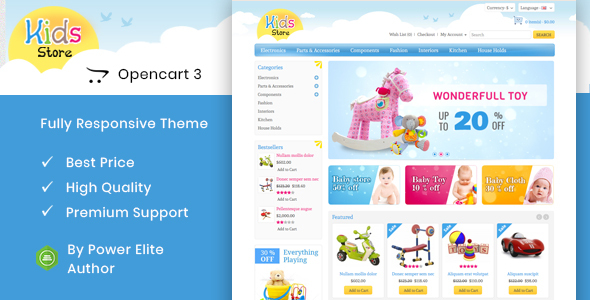
Kids Store is a responsive OpenCart theme built for shops that sell toys, children’s clothing and similar products. It packages a colourful storefront design with a fluid grid layout, slider and banner management, and full PSD source files, and it is aimed at store owners or freelancers who want a ready-made front end for a Kids Store Ecommerce project rather than a custom build. The theme is sold on ThemeForest for $39 and has been purchased 305 times.
TemplateMela, the developer behind the theme, has kept it updated across a wide span of OpenCart releases, from the 1.5.6 branch through to 3.0.3.x. That long compatibility list is the single most useful fact about the product, because it determines whether the theme will install on the version of OpenCart already running on a server.
What the Kids Store Ecommerce theme actually includes
The headline feature is the responsive layout. The grid is fluid, which means product columns reflow to fit the screen instead of being locked to a fixed pixel width. On a phone, a shopper browsing a toy catalogue gets a layout sized for a thumb rather than a shrunken desktop page. The vendor also ships a “smart responsive product grid” and a FlexSlider, both of which are front-end presentation components rather than separate plugins.
Merchandising tools are where the theme does most of its work for a Kids Store Ecommerce site:
- Unlimited banners and sliders. A shop can rotate seasonal promotions, such as a back-to-school banner or a birthday-gift slider, without editing template files.
- Featured products slider. Highlights a hand-picked set of items on the homepage, which matters in a category where parents often shop by age band or occasion rather than by brand.
- Cloud Zoom. Enlarges product photography on hover or tap. For toys, where colour and small parts are part of the buying decision, this reduces returns caused by mismatched expectations.
- Related product scroller. Adds a horizontally scrolling strip of alternatives on the product detail page, useful for cross-selling accessories such as batteries or replacement parts.
- Cart dropdown in the header. Lets a shopper confirm what is in the basket without leaving the page they are browsing.
- CMS blocks module. Provides editable content areas for delivery notes, age-suitability guidance or gift-wrapping information.
On the technical side, the theme is built with HTML5 and CSS3, uses Google Fonts, and supports multiple languages including right-to-left scripts. RTL support is not decoration: a store selling into Arabic or Hebrew markets needs mirrored layouts, and many budget themes skip it entirely. The vendor states there are no core modifications, which means the theme overrides OpenCart’s presentation layer rather than altering the platform itself. That distinction matters at upgrade time, because a modified core makes applying OpenCart security patches risky.
Other inclusions: CSS sprite optimisation for faster loading, valid XHTML and CSS markup, browser compatibility across the major engines, commented code, a user guide, and full PSD files so a designer can rebuild the graphics. The vendor also claims the theme avoids JavaScript conflicts, which is a common failure point when a storefront loads several third-party extensions at once.
Where this theme fits, and where it does not
The strongest fit is an existing OpenCart store that already runs one of the supported versions and needs a category-appropriate skin. A shop selling wooden toys, baby clothing, party supplies or educational games can install this, swap in its own logo and product photography, and have a presentable storefront without commissioning a design.
It also suits freelancers and small agencies delivering a fixed-scope build on a tight budget. The PSD files and commented markup mean a designer can restyle colours and typography without reverse-engineering the layout, and the CMS blocks module gives a client something to edit after handover.
Multilingual retailers are a third reasonable fit, particularly those selling into RTL-language markets where the alternative is paying for custom mirroring work.
Where it is the wrong choice: a store on OpenCart 4.x. The compatibility list stops at 3.0.3.x, and the vendor’s last functional update was in September 2021. Anyone planning a new build on a current OpenCart release should treat this theme as unsuitable rather than assume forward compatibility. It is equally wrong for a merchant who wants a headless or API-first storefront, since this is a traditional server-rendered theme with no headless story.
Setting it up in practice
Installation assumes a working OpenCart installation already exists. The theme is not a hosted service and does not include hosting, so the prerequisites are a server running a supported OpenCart version, a database, and file system access for uploading the theme package. The vendor supplies a user guide covering installation and configuration.
The practical sequence is: confirm the OpenCart version matches the compatibility list, back up the store, upload and install the theme package, then activate it and clear the theme cache. From there, configuration moves to the admin panel — assigning the homepage sliders and banners, placing the CMS blocks, setting the featured products list, and uploading a logo. Product images need to be large enough to make the Cloud Zoom feature worthwhile; a zoom tool applied to a small image simply produces a blurry enlargement.
A straightforward install on a prepared store is an afternoon’s work for someone comfortable with OpenCart’s admin. The longer part is content: banners, slider images, category structure and product photography for a Kids Store Ecommerce catalogue typically take considerably longer than the technical setup. Stores with heavy customisation needs, or with existing extensions that hook into the product page, should budget extra time for testing, because extension and theme conflicts are the most common source of layout breakage.
Strengths and limitations
Strengths
- Broad OpenCart version support, spanning 1.5.6.x through 3.0.3.x, which covers a large installed base of older stores.
- RTL language support included as standard, which is uncommon at this price point.
- No core file modifications, keeping the platform upgradeable and patchable.
- Full PSD files and commented code, so visual changes do not require rebuilding the template from scratch.
- Merchandising features — sliders, featured products, related product scroller, cart dropdown — are bundled rather than sold as add-ons.
- 305 sales and a $39 price point make it a low-risk purchase relative to a custom theme build.
Limitations
- The last functional update was September 2021, and the changelog shows several entries that only changed the preview image or fixed minor issues. The theme is maintained, but not actively developed.
- OpenCart 4.x is not supported. Any merchant on the current major release is excluded.
- The visual design is fixed to a bright, child-oriented palette. It is not a neutral base that adapts to a premium or minimal brand without design work.
- There is no page builder. Layout changes require editing template files and CSS, which puts meaningful customisation out of reach for non-technical owners.
- The vendor does not state performance benchmarks, accessibility conformance level, or a support response time, so those cannot be verified from the listing.
How it compares with other OpenCart themes
OpenCart themes generally fall into three groups: free themes from the marketplace, paid niche themes like this one, and premium multipurpose themes that cost several times more and bundle a page builder.
Against free themes, the case for Kids Store is the bundled extras — PSD files, RTL support, CMS blocks, Cloud Zoom — plus a documented update history. Free themes rarely include source files or documentation, and support is usually limited to forum threads.
Against premium multipurpose themes, the trade-off runs the other way. A multipurpose theme gives more layout freedom and typically receives more frequent updates, but it costs more and requires more configuration to reach a finished look. Kids Store is narrower: it arrives styled for a children’s retail catalogue, so less setup is needed, but there is less room to depart from that look.
The deciding factor is usually OpenCart version. If the store runs 3.0.3.x or earlier and the budget is small, this theme competes well. If the store runs 4.x, or the roadmap includes it, the theme is out of contention regardless of price.
Frequently Asked Questions
Which OpenCart versions does Kids Store support?
It supports OpenCart 1.5.6.x, the 2.0.x, 2.1.x, 2.2.x and 2.3.x branches, and 3.0.2.x and 3.0.3.x. OpenCart 4.x is not on the compatibility list, and the vendor’s last functional update was September 2021, so stores on the current major release should look elsewhere or plan an upgrade path first.
Does the theme work on mobile devices?
Yes. The layout is fully responsive with a fluid grid, so product columns and navigation adapt to phone and tablet screens rather than shrinking a desktop layout. The vendor also ships a responsive product grid and a FlexSlider, and the September 2015 changelog shows CSS fixes specifically for responsive view.
Can the design be customised without touching code?
Partly. Banners, sliders, featured products and CMS blocks are all managed from the OpenCart admin panel, so day-to-day content changes need no coding. Changing colours, typography or layout structure does require editing template files and CSS, and the supplied PSD files help designers rebuild graphics.
Is RTL language support included?
Yes, RTL language support is included, along with multiple language support and Google Fonts. That makes the theme usable for stores targeting Arabic, Hebrew or other right-to-left script markets, where layouts need to mirror horizontally. Many themes at this price point omit RTL handling, so it is a genuine differentiator.
Verdict
Kids Store is a sensible purchase for an existing OpenCart store on version 3.0.3.x or earlier that sells toys, children’s products or party goods and needs a category-appropriate front end without a custom build. The combination of RTL support, PSD files, no core modifications and a $39 price makes it low-risk for freelancers delivering small retail projects. It is not the right choice for anyone on OpenCart 4.x, for merchants who want a page builder and drag-and-drop layout control, or for brands whose visual identity cannot accommodate a bright, child-focused palette. Buyers should treat the 2021 update date as the key signal: the theme still works on its supported versions, but it is a finished product rather than an actively evolving one.