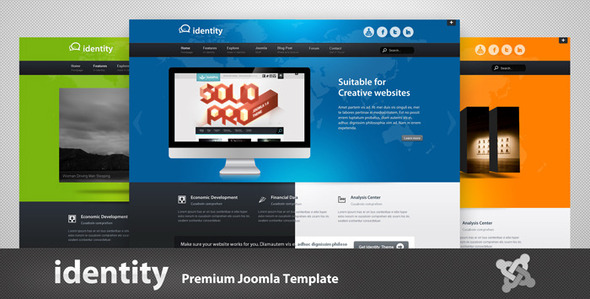
Identity is a premium Joomla template sold on ThemeForest for $30, built by the developer Twincore for Joomla 1.6, 1.7 and 2.5. It targets businesses, creative studios, portfolios and blogs, and it ships with a T3 Framework v2 base, 25 colour schemes, mega and dropline menus, and a large shortcode library. Among Identity Cms Themes it stands out for breadth of built-in styling rather than for modern development practices, and it is best understood as a product of its era.
What Identity Cms Themes Actually Deliver in the Box
The template’s most visible selling point is colour. Identity ships with 25 named style variations, ranging from the default Azure Moderate through Crimson Deep, Turquoise Dark and Yellow Strong Amber. Each is a preset rather than a blank canvas, so a site can be re-skinned by switching a setting instead of editing stylesheets. For an agency producing several small business sites in quick succession, that saves real hours.
Navigation is handled by two menu systems. The default is a mega menu, which lets a single top-level item expand into a wide panel containing links, images or grouped columns. The alternative is a dropline menu, which unfolds downward in a more conventional cascade. Both are configured through the T3 Framework rather than by hand-coding HTML, which keeps the markup consistent across pages.
Layout flexibility comes from eight predefined column arrangements. Six are three-column combinations that shuffle content, a narrow left rail and a wider right rail into different orders; two are simpler two-column setups. The template also offers a fixed 980-pixel wide screen mode as the default and a fluid option that stretches to the browser window. That choice matters for older corporate sites that were designed around a fixed grid.
Slideshows are unusually well covered. The package includes Tabs GK4, the Yj Piecemaker 3D slider and five separate Nivo Slider styles, plus two content sliders from Gavick. Rather than installing a slideshow extension separately, a site owner can pick from a menu of pre-styled options. The shortcode set is similarly broad: highlights, blockquotes, drop caps, list styles, legend and note boxes, buttons, icon boxes, image frames, accordions, an FAQ element, three table styles, action button links and both single and multi-column pricing boxes. Several of these are explicitly aimed at business pages, which tells you where the template expects to be used.
There are 28 module positions, and the vendor notes that additional positions can be created. Module suffixes include four badge styles for left and right columns. The template also includes an iPhone-specific view, an error page style and an offline page style.
Where Identity Fits and Where It Does Not
Identity suits small and mid-sized brochure sites: a consultancy, an accountancy practice, a design studio, a photographer’s portfolio or a company blog. The pricing boxes, action buttons and table styles are ready-made for service pages that need to present tiers or compare features. A freelancer building a handful of client sites on Joomla 2.5 would find the preset colour schemes and shortcodes cut production time considerably.
It is a poor fit for anyone starting a new project today. Joomla 2.5 reached end of life in 2014, and the template’s last vendor update was February 2013. Running it means running an unsupported content management system, which brings security and hosting complications that no amount of styling convenience justifies. It is also the wrong choice for a web application, a membership platform or anything needing modern accessibility standards, because the markup and framework predate current expectations.
A third scenario worth flagging: agencies maintaining an existing Joomla 1.6, 1.7 or 2.5 site that already uses Identity. For a like-for-like refresh or a new section on an established installation, the template remains workable precisely because the surrounding stack is already fixed.
Setting Up the Template in Practice
Installation assumes a working Joomla 1.6, 1.7 or 2.5 installation. Identity runs on T3 Framework v2, so the framework needs to be present and is bundled with the package. The vendor supplies quickstart packages, which are pre-configured Joomla installations containing the template, sample content and extensions already wired together. Using a quickstart is by far the faster route: it produces a site resembling the demo in perhaps half an hour, including the time spent adjusting colours and swapping placeholder images.
Building on an existing site instead means installing the template, the T3 framework, the bundled plugins and any of the third-party extensions required for the features in use. Several components are not written by Twincore: the slideshows come from Gavick and Yj, the accordion module from Lof, and the credits list also references Kunena, Acymailing, ZOO and a social media icon module. Each has its own configuration. Realistically, a manual setup on a live site takes an afternoon or more, and troubleshooting extension conflicts is the most likely source of delay.
The vendor directs buyers to read the help documentation before asking questions and points to a support forum for problems. That is the extent of what the listing states about support; there is no published response-time commitment or support period.
Strengths and Limitations
Strengths
- Twenty-five ready-made colour schemes remove most routine styling work from a small business build.
- Eight layout variations and a choice of fixed or fluid width cover the common corporate page structures without custom CSS.
- Seven slideshow options and a substantial shortcode library mean fewer paid or free extensions to source, install and maintain.
- Quickstart packages let a demo-like site be running quickly, which is useful for pitching or prototyping.
- At $30 with 351 sales, the price-to-feature ratio is favourable for anyone already committed to Joomla 2.5.
Limitations
- The last vendor update was February 2013, and the supported Joomla versions are all long past end of life. There is no path to Joomla 3 or 4.
- Much of the functionality depends on third-party extensions from other developers, so the template’s longevity is tied to software Twincore does not control.
- The fixed default width of 980 pixels is narrow by current standards and will look dated on large displays unless the fluid option is used.
- The iPhone view is a separate mobile style rather than a responsive layout, so tablet and other screen sizes are not addressed.
- Support is forum-based with no stated response time, which is a meaningful risk on a product this old.
How Identity Compares With Other Joomla Template Options
Within the Joomla template category, products generally divide into two groups: current templates that track the latest Joomla release and include responsive layouts, and legacy templates frozen at an older version. Identity sits firmly in the second group. Judged against current templates, it loses on the fundamentals — responsive design, accessibility, modern framework support and ongoing maintenance.
Judged against other legacy Joomla 2.5 templates, however, it compares well on configuration depth. Many templates from the same period offered a handful of colour presets and one slider. Identity offers 25 colour schemes, seven slideshow options, eight layout arrangements and a shortcode set that covers pricing tables and FAQ blocks. For a site already running Joomla 2.5, that breadth is the reason to pick it over a plainer alternative. The trade-off is that a lighter template with fewer bundled extensions will be easier to keep stable.
Frequently Asked Questions
Which Joomla versions does Identity support?
Identity supports Joomla 1.6, 1.7 and 2.5. The most recent version, 1.1, was released for Joomla 2.5 in February 2013 and updated the quickstart packages to Joomla 2.5.9. There is no version for Joomla 3 or Joomla 4, and the vendor has published no update since 2013, so it cannot be used on a current Joomla installation.
Does the Identity template include a responsive mobile layout?
No. Identity provides a dedicated iPhone view rather than a responsive layout that adapts to any screen size. That means phones get a purpose-built style, but tablets and other viewport widths are not specifically handled. Sites built with the template will generally need separate consideration for mid-sized screens, which is a notable gap compared with modern responsive templates.
What is included in the Identity quickstart package?
The quickstart packages are pre-configured Joomla installations that bundle the template, the T3 Framework, sample content and the extensions used in the demo. Installing one produces a site closely resembling the live demo, which is the fastest way to evaluate the template. The vendor updated the quickstarts to Joomla 2.5.9 in the February 2013 release.
Is Identity suitable for a new website project?
Generally no. Because it only runs on end-of-life Joomla versions, a new site built on Identity would launch on an unsupported platform with no security updates. The template remains reasonable for maintaining or extending an existing Joomla 2.5 site, but new projects are better served by a template built for a currently supported Joomla release.
Verdict
Identity is worth buying only in one specific situation: an existing Joomla 2.5, 1.7 or 1.6 site that needs a new section, a redesign or a replacement licence, and where the surrounding stack is already fixed. In that narrow case, the 25 colour schemes, eight layouts and extensive shortcode library make it a capable and inexpensive option, and the 351 sales suggest it found a real audience when it was current.
For anyone launching a new site, the calculus is different. The template has not been updated since February 2013, supports only retired Joomla versions, and depends heavily on third-party extensions the developer does not maintain. Those are not minor caveats; they are disqualifying for a new build. Buyers should treat Identity as a legacy maintenance purchase, not a foundation for anything new.