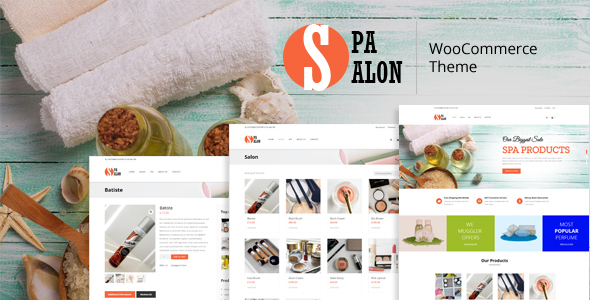
SPASALON Ecommerce is a WooCommerce WordPress theme sold on ThemeForest for $59, built by the developer kayapati for spa, salon, massage, beauty and healthcare businesses that sell online. It pairs the WooCommerce shop system with Elementor, the drag-and-drop page builder, and adds custom-built Elementor blocks aimed at treatment menus, service listings and booking-style layouts. It suits small salon and spa operators who want a ready-made storefront they can restyle without writing code, and it has drawn 256 sales since its last update in July 2019.
What SPASALON Ecommerce actually gives a salon or spa site
The theme’s core proposition is that a beauty or wellness business should not have to assemble a shop from a generic multipurpose template. The vendor has designed the demo pages around the visual language of the sector — soft palettes, large treatment imagery, service cards — and then handed control of those pages to Elementor.
The most consequential capability is the Elementor integration. Elementor is a visual editor that lets a site owner drag rows, columns and widgets onto a page and see the result live, rather than working inside the WordPress block editor or a shortcode system. Because SPASALON ships with custom Elementor widgets written specifically for it, common salon page components — treatment price lists, staff or therapist profiles, service grids, opening-hours blocks — can be dropped in and edited rather than rebuilt from scratch. That is the difference between a theme that merely looks like a spa site and one that lets a non-developer maintain one.
The WooCommerce layer is what turns the site into a store. WooCommerce is the free WordPress plugin that handles products, variations, cart, checkout and payment gateways. In practice this means a spa can sell physical goods (retail skincare, oils, gift sets) and, with the right add-on plugins, sell bookable services or vouchers as products. The theme provides the presentation layer for those product pages; it does not itself add booking logic, calendar availability or staff scheduling. Anyone expecting the theme to manage appointments out of the box will need a separate booking plugin such as a WooCommerce bookings extension.
Beyond that, the vendor claims every element on the theme is editable, which in Elementor terms means global colours, typography and spacing can be changed once and inherited across the site. For a salon that rebrands seasonally or runs promotions, that is a meaningful time saver. The vendor does not publish a detailed list of bundled plugins, layout counts or supported page-builder alternatives in the listing, so those specifics should be confirmed before purchase.
Where this theme fits, and where it does not
The clearest fit is a single-location salon, day spa or massage studio that wants a brochure-plus-shop website — treatment pages, an about section, a small product catalogue and a contact or enquiry form — and has someone comfortable with Elementor. It also works for a beauty clinic or wellness centre that sells retail products alongside services and wants those products presented in a coherent, sector-appropriate design rather than a generic storefront template.
Freelancers and small agencies building for salon clients are a second natural audience. The Elementor base means handover is straightforward: a client can be taught to edit text and swap images without touching code, and the custom widgets reduce the build time on repeated salon projects.
The theme is a poor choice in three situations. First, if the site must handle real appointment booking with staff calendars, deposits and rescheduling, the theme contributes nothing to that problem and the budget should go to a dedicated booking platform instead. Second, if the project needs to run on Gutenberg blocks or a different builder such as WPBakery, the Elementor dependency becomes a constraint rather than a convenience. Third, if the client expects long-term platform support and compatibility with current WordPress and WooCommerce releases, the 2019 last-updated date is a genuine warning sign — more on that below.
What setup involves in practice
Installation follows the standard WordPress route: a working WordPress installation on hosting that meets WooCommerce’s requirements (PHP 7.4 or newer is the practical floor, with a recent MySQL or MariaDB version), then the theme uploaded through Appearance → Themes or the ThemeForest installer. WooCommerce is installed as a separate plugin and its setup wizard walks through store address, currency, shipping and payment.
Elementor is the other prerequisite. The theme’s demo pages are Elementor layouts, so without the free Elementor plugin the design does not render as intended. Importing the demo content — usually a one-click step in themes of this type — gives a populated site to work from, which is faster than building pages from a blank canvas.
Realistic timing: a competent WordPress user can have the demo imported, colours and fonts swapped and the logo in place within a few hours. Replacing demo copy and imagery with real treatment descriptions, prices and photography is the bulk of the work and typically takes a day or two depending on catalogue size. Connecting a payment gateway and testing a live transaction adds an hour or so. A developer building custom Elementor templates on top of the theme should budget closer to a week.
Strengths and limitations
Strengths
- Sector-specific design: the demo layouts are built for spa, salon and wellness content, so treatment menus and service cards look intentional rather than adapted from a corporate template.
- Custom Elementor widgets reduce build time for the page components salon sites use most.
- WooCommerce integration means retail products, vouchers and gift cards can be sold without a separate storefront.
- Global styling controls make rebrands and seasonal promotions quick to apply.
- At $59 it is inexpensive relative to a custom build, and 256 sales indicate a real, if modest, user base.
Limitations
- The theme was last updated in July 2019. WordPress, WooCommerce and Elementor have all changed substantially since then, and a theme that has not tracked those releases carries real risk of styling conflicts, deprecated function warnings or breakage on current PHP versions. Confirm current compatibility with the vendor before buying.
- No booking or appointment functionality is included. Scheduling, staff availability and deposits require a separate plugin and additional cost.
- Elementor is a hard dependency. Teams standardised on Gutenberg or another builder cannot use the theme’s layouts without switching tools.
- The vendor listing does not document the number of demo layouts, bundled plugins or support terms, which makes pre-purchase comparison harder than with better-documented themes.
- Design trends in beauty and wellness web design have moved since 2019; some buyers will want to restyle more heavily than the demo suggests.
How SPASALON Ecommerce compares with the wider theme market
Against general multipurpose WooCommerce themes, SPASALON trades flexibility for fit. A multipurpose theme can be bent into any sector and usually ships with more demos, more frequent updates and larger support teams, but a salon owner then spends hours removing corporate layouts and rebuilding service pages. SPASALON starts closer to the finished result, which is worth more to a small operator than raw configurability.
Against dedicated salon and spa themes, the comparison turns on maintenance and booking. Several competitors in this niche bundle or integrate booking plugins directly; SPASALON does not, so its total cost of ownership includes a booking add-on. The more important differentiator is update cadence — a theme actively maintained through 2024 and beyond is safer for a client site than one frozen in 2019, even if the older design is more attractive.
Against a custom build, the theme wins on cost and speed by a wide margin and loses on uniqueness and long-term control. For a single salon with a modest budget, that trade is usually correct; for a multi-location spa group with complex booking and membership needs, it is not.
Frequently Asked Questions
Does SPASALON include appointment booking?
No. SPASALON provides the design and the WooCommerce shop, but it does not include scheduling, staff calendars or deposit handling. Appointment functionality must come from a separate booking plugin, either a WooCommerce bookings extension or a standalone salon booking plugin. Budget for that plugin and for the time to configure it when assessing the total cost.
Is SPASALON compatible with the current version of WordPress?
That is unconfirmed. The vendor’s last recorded update was July 2019, and the listing does not state compatibility with recent WordPress, WooCommerce or PHP releases. Buyers should ask the developer directly before purchase, and should test on a staging copy of the site rather than a live store, since theme conflicts typically surface in checkout and product templates.
Do I need to know how to code to use this theme?
No coding is required for ordinary editing. Pages are built with Elementor, a visual drag-and-drop editor, and the theme’s custom widgets are configured through settings panels. Basic WordPress familiarity — installing plugins, creating pages, adding products in WooCommerce — is enough. Custom functionality beyond what the widgets offer would still need a developer.
Can SPASALON sell physical products as well as services?
Yes, for physical products. WooCommerce handles product listings, variations, stock, shipping and payment gateways, and the theme styles those pages. Services can be listed as products too, but without a booking plugin they behave like simple purchasable items rather than scheduled appointments, so the practical distinction matters for how the catalogue is structured.
Verdict
SPASALON Ecommerce is a sensible buy for a single salon, spa or massage studio with a limited budget, an existing WordPress host and someone comfortable in Elementor who wants a sector-appropriate storefront quickly. It is also a reasonable starting point for freelancers who build salon sites repeatedly and want a familiar base. It is not the right choice for projects that need built-in booking, for teams committed to a different page builder, or for client sites where long-term vendor maintenance is a hard requirement — the 2019 update date makes that last point decisive. Buyers in that final group should either confirm current compatibility in writing with the developer or look at actively maintained alternatives in the same niche.