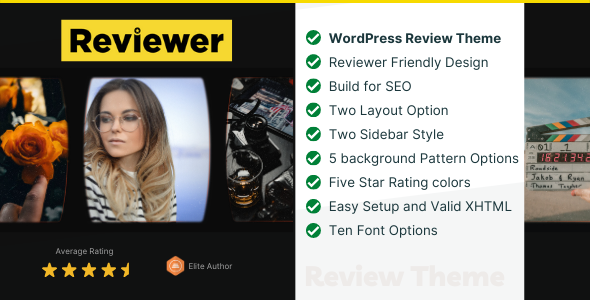
Reviewer Entertainment is a WordPress theme built specifically for publishing scored reviews of films and television shows. It ships with star ratings, a ratings chart widget, author profile pages and a set of layout controls aimed at small editorial sites rather than general-purpose blogs. It suits a solo critic or a small review team that wants a ready-made structure, and it is a poor fit for anyone who needs modern block-based editing or long-term theme support.
What Reviewer Entertainment Actually Does Well
The theme’s organising idea is that a review is a different kind of post from an ordinary article, and the design reflects that. Ratings are treated as a first-class element rather than something bolted on with a plugin, which keeps the writing workflow short.
The five-star rating system is the centre of the product. It offers five colour presets for the stars, so a site can match its branding without touching stylesheets. Scores are attached to individual posts, which means a movie review and a TV episode review can both carry a visible score in the same archive.
A custom widget called Recent Ratings produces a graph of the latest scores. For a review site, this is more useful than a plain list of recent posts, because it shows at a glance whether the site has been generous or harsh lately. A second custom widget highlights a featured reviewer or author, giving a named writer a visible slot on the homepage rather than burying the byline.
The Author’s Page Template generates a page listing every writer on the site. On a multi-contributor review publication, that page does double duty as an editorial masthead and as a set of internal links pointing at each writer’s archive, which helps with both navigation and search visibility.
Homepage curation relies on WordPress sticky posts. Marking a post as sticky promotes it into a featured area on the front page, and the theme adds jQuery hover effects to those items. This is a familiar pattern: no separate slider plugin, no extra settings screen, just the native WordPress mechanism.
Presentation controls are broader than the feature list first suggests. There are ten Google Fonts to choose from, five background patterns, two content-and-sidebar layout arrangements, two sidebar styles, and colour pickers for link colours. The sidebar and footer are both widgetised, so promotional blocks, category lists and newsletter signup forms can be placed without code. Social network icons are included for linking out to a publication’s accounts.
Two practical details matter for anyone outside the English-speaking market. A translation file is bundled, so the interface strings can be localised into another language, and the theme supports Contact Form 7 for contact and tip-off forms. The markup is described as valid XHTML, and the vendor provides documentation intended to be followed without developer help.
Where Reviewer Entertainment Fits, and Where It Does Not
The strongest fit is a single-critic film or TV site that publishes scored reviews on a regular schedule and wants the score to be the visual anchor of every post. A small team running a review section inside a larger entertainment site is the second good fit, particularly because of the author listing page and the featured reviewer widget.
It also works for niche review verticals that share the same shape as film criticism: streaming series, anime, documentaries, or a personal log of everything watched in a year. Anywhere a numeric score plus a written verdict is the core content unit, the theme’s defaults line up with the job.
Where it is the wrong choice is equally clear. A site that needs episode guides, cast databases, watch-order lists or user-submitted ratings is asking for functionality this theme does not provide. A publication built on the WordPress block editor and modern full-site editing will find the theme’s older, customiser-driven approach restrictive. Anyone who needs a theme that is actively maintained should also look elsewhere: the last vendor update recorded is March 2021, and the changelog is the only place the vendor documents changes.
Setting Up Reviewer Entertainment in Practice
Installation follows the standard WordPress route: upload the theme package through the admin, activate it, then work through the customiser. The prerequisites are modest. A self-hosted WordPress installation is required, along with the ability to install plugins if Contact Form 7 is wanted. No page builder is needed, and no paid add-ons are referenced.
The realistic sequence is to set colours, fonts and background pattern first, since those decisions affect everything downstream. Next comes the layout choice between the two content and sidebar arrangements, then widget placement in the sidebar and footer. After that, a reviewer creates the author listing page using the dedicated template and assigns posts to writers.
Content entry is where the theme earns its keep. Each review is a normal post with a score attached, so a writer who already knows WordPress needs no new mental model. The vendor recommends building a child theme for any code changes, which is sound advice: it keeps the parent theme replaceable when bug fixes arrive.
A first working site is realistically an afternoon’s work for someone comfortable with WordPress, and a day or so for someone who is not. The bundled documentation is described as easy to follow, though the vendor does not state how extensive it is.
Strengths and Limitations
Strengths
- Purpose-built rating system with five star colour presets, so scores are part of the theme rather than a plugin dependency.
- Recent Ratings graph widget gives an editorial overview that generic recent-posts widgets cannot.
- Author listing template and featured reviewer widget support multi-writer publications.
- Translation file included, which opens the theme to non-English markets.
- Broad styling controls — ten fonts, five background patterns, two layouts, two sidebar styles and link colour pickers — without requiring CSS edits.
- Widgetised sidebar and footer, plus Contact Form 7 support, cover the usual peripheral needs.
- 504 sales on ThemeForest indicate a reasonable installed base for a niche theme.
Limitations
- The last recorded update is March 2021. Compatibility with the newest WordPress releases is not something the vendor states, and buyers should verify it before committing.
- There is no block editor or full-site editing support described. Layout changes go through the customiser, which limits how far the design can be reshaped.
- Ratings are a single score per post. There is no half-star granularity, no multi-criteria scoring such as separate marks for story and direction, and no user-submitted ratings.
- Featured homepage content depends on sticky posts, which means the homepage cannot be composed freely from arbitrary blocks.
- No schema markup for review rich snippets is mentioned, so structured data would need to come from an SEO plugin.
- The feature set is narrow by design. Sites needing cast pages, episode guides or watchlists will have to build them separately.
How Reviewer Entertainment Compares With the Wider Category
Review themes sit between two broader groups: multipurpose entertainment themes and general magazine themes with a review plugin attached. The multipurpose route offers more page templates and more frequent updates, but the rating experience is usually assembled from a plugin, which means an extra dependency and a second settings interface. The plugin route is more flexible on scoring criteria, yet the visual integration is rarely as tight.
Reviewer Entertainment takes the opposite trade-off. It does one job, does it inside the theme, and asks for very little configuration. That is an advantage for a site whose content is genuinely just reviews, and a constraint for a site that wants reviews to be one section among many. Compared with a custom build, it is faster and cheaper; compared with a modern block theme, it is older and less adaptable. The decision comes down to whether the narrow, opinionated feature set matches the publication’s actual output.
Frequently Asked Questions
Is Reviewer Entertainment compatible with the latest WordPress version?
The vendor does not state current compatibility. The last recorded update was March 2021, which predates several major WordPress releases, so the theme has not been kept in step with recent core changes. Testing on a staging copy before installing on a live site is the sensible approach, and checking the changelog for newer entries is worthwhile.
Can Reviewer Entertainment handle TV show reviews as well as movie reviews?
Yes. The theme is not restricted to films, and the vendor explicitly describes it as suitable for both movies and TV shows. Any content type that fits a scored review format — streaming series, documentaries or anime — can use the same rating system, author pages and ratings graph without modification.
Does Reviewer Entertainment support multiple review criteria or half stars?
No. The rating system is a single five-star score per post, with five colour presets for the stars. The vendor does not describe half-star values or separate scores for different aspects such as acting, writing and direction. Sites needing multi-criteria scoring would require a dedicated review plugin instead.
Can the theme be translated into another language?
Yes. A translation file is bundled with the theme, which allows the interface strings to be localised. That makes Reviewer Entertainment usable for non-English review sites without editing template files directly. The vendor does not state which translation method or tooling the file uses, so the exact workflow depends on the file format supplied in the package.
Verdict
Reviewer Entertainment is worth buying for a solo critic or small review team that wants a scored film or TV site running quickly, values the ratings graph and author listing features, and is comfortable working within the classic WordPress customiser. The 504 sales suggest a settled niche audience rather than a mass-market product, and the bundled translation file widens its appeal beyond English.
It is not the right purchase for anyone who needs active development, block-based design flexibility, multi-criteria scoring or user-submitted ratings. Those requirements point to a maintained multipurpose theme paired with a dedicated review plugin. The deciding factor is whether the site’s content really is reviews and nothing else — if so, the narrow focus is a benefit rather than a limitation.