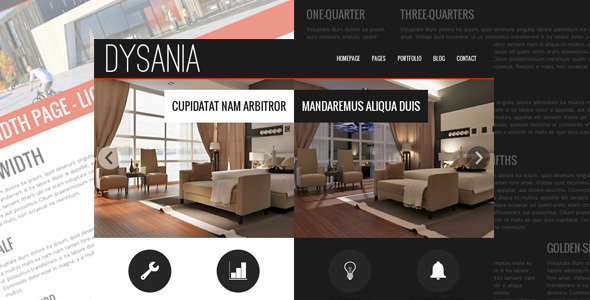
Dysania is a static HTML5 and CSS3 template built for small business and corporate websites, sold on ThemeForest by developer egemenerd for $9. It packages 18 pre-built pages in two colour schemes — a light set and a dark set — aimed at agencies, interior and architecture studios, beauty and health businesses, and similar service firms that want a finished site without a CMS. It is the right buy for a freelancer or small studio that needs a fast, cheap, hand-coded brochure site and is comfortable editing HTML directly.
The template has recorded 248 sales on the marketplace, which is modest but not trivial for a niche static template, and it puts the product in the low-cost end of the business template category. That price and sales history shape how it should be judged: not against flagship multipurpose themes, but against what a buyer can realistically expect from a nine-dollar HTML download.
What the Dysania- Responsive Multi-Purpose HTML Template actually delivers
The core offer is a set of finished pages rather than a page builder. Buyers get 18 layouts covering the usual business site furniture — home, about, services, portfolio, blog and contact — and each page exists in both a light and a dark variant, which the vendor markets as a “2 in 1” package. In practice that means a site can be skinned either way without hunting for a second template.
Colour and typography are handled through a separate CSS file, so the palette and font choices can be swapped without opening Photoshop or rebuilding the layout. The vendor states that all colours sit in that one file, which is the single most useful structural decision in the package for anyone who needs to match an existing brand.
Two sliders ship with it: Flexslider and a premium slider called Zeus Slider, which the vendor values at $7 on its own — close to the price of the whole template. A custom portfolio page, an under-construction page, a Flickr feed, a working contact form, and ready-made components (accordion, tabs, quote rotator, galleries) round out the build. jQuery and CSS3 animations are used throughout for movement on scroll and hover.
Browser support is listed as cross-browser, and the markup is valid HTML5 and CSS3. The demo images come from Flickr and are explicitly not included in the download, so any buyer will need to source their own photography before the site looks finished.
Where this template fits, and where it does not
The strongest fit is a service business that needs a compact marketing site — an interior design studio, an architecture practice, a beauty salon, a small clinic, or a boutique agency. These are exactly the verticals the vendor names, and the light/dark pairing suits businesses that want a moodier, image-led look without paying for custom design work.
It also suits freelancers building a client site on a tight budget and a tight timeline. At $9, the template costs less than an hour of most freelancers’ time, and the pre-built pages remove the layout work that eats into small projects.
It is the wrong choice for anyone who needs a blog with real content management, e-commerce, multi-language support, or a client who will want to edit pages themselves. This is a static template: there is no admin panel, no database, and no WordPress behind it. A business that expects to publish weekly posts or change copy without a developer should be looking at a CMS theme instead. It is also a poor fit for projects that need modern accessibility standards or current framework conventions, for reasons covered below.
What setup involves in practice
There is no installation process in the CMS sense. A buyer downloads a ZIP, unzips it, and opens the HTML files in an editor. From there the work is: replace the placeholder copy and demo images, edit the colour and font variables in the separate stylesheet, adjust the logo, and point the contact form at a mail handler. The contact form is described as working, but any static form still needs a server-side script or a form service to actually send mail — the vendor does not state which handler is assumed, so that step should be planned for.
The prerequisites are basic HTML and CSS literacy, plus access to web hosting that serves static files. No build tools, package managers, or command line are required. For someone comfortable with markup, a straightforward site can be assembled in a few hours; a less experienced buyer should budget a full day or more, mostly for image sourcing and copywriting rather than code.
One practical caveat: the vendor’s last recorded update is November 2016, and the update history in the listing only goes back to early 2014. The template has not been refreshed in a long time, so buyers should expect to modernise details themselves.
Strengths and limitations
Strengths
- Very low price relative to the number of finished pages included.
- Light and dark variants double the design options without a second purchase.
- Colours and fonts are centralised in one CSS file, making rebranding quick.
- Two sliders included, one of them a paid premium plugin bundled at no extra cost.
- Useful extras — under-construction page, portfolio layout, working form — reduce the number of separate pieces a freelancer has to assemble.
- Clean, flat visual style that still reads as contemporary for service businesses.
Limitations
- Static HTML only: no CMS, so content updates require editing files by hand.
- Last updated in 2016, meaning the code predates current accessibility expectations and modern CSS layout practices; buyers may need to retrofit improvements.
- Demo images are not included, so the site will look unfinished until photography is sourced and licensed.
- No documentation is described in the listing beyond the feature list, so troubleshooting falls to the buyer.
- The bundled slider and gallery scripts are older jQuery plugins, which adds maintenance overhead if the site is kept long-term.
How it compares with the wider category
Multipurpose HTML templates generally compete on page count, design polish, and how easily the buyer can rebrand them. Dysania’s edge is the light/dark pairing and the centralised colour file, which is more than many budget templates offer. Its weakness is age: newer templates in the same category typically ship with modern CSS grids, updated slider libraries, and clearer documentation.
Against CMS-based business themes, the trade-off is control versus convenience. A static template gives full control of the markup and no plugin bloat, but it hands all content editing to a developer. For a one-off brochure site that will rarely change, that is a reasonable trade. For a site that will grow, it is not.
Frequently Asked Questions
Is Dysania a WordPress theme?
No, Dysania is a static HTML5 and CSS3 template, not a WordPress theme. It consists of plain HTML pages with linked stylesheets and JavaScript, and it cannot be installed through a WordPress dashboard. Buyers who need a CMS-driven site should choose a WordPress theme instead, or expect to convert the markup into a theme themselves.
Can the Dysania template be rebranded with my own colours and fonts?
Yes. The vendor keeps all colours in a separate CSS file, so the palette and typography can be changed by editing that one stylesheet. No Photoshop work is required for colour changes. Fonts used in the demo are Oswald and Open Sans, and swapping them means updating the font references alongside the stylesheet.
Does the template include the images shown in the demo?
No, the demo images are not included in the download. They are sourced from Flickr and remain the property of their original photographers. Buyers must supply their own licensed photography, which is a real cost to budget for — stock licences can easily exceed the price of the template itself.
Is Dysania still maintained or updated?
No recent updates are recorded. The vendor’s last listed update is November 2016, and the visible update history stops in early 2014. The template still works as static markup, but buyers should assume no ongoing support for modern browser quirks or accessibility fixes and plan to handle those themselves.
Verdict
Dysania- Responsive Multi-Purpose HTML Template business buyers should consider it if they need a cheap, good-looking static site for a service business and are comfortable editing HTML and CSS. Freelancers building compact brochure sites on tight budgets will get solid value from the 18 pages and dual colour schemes. Buyers who need a CMS, regular content updates, or modern accessibility out of the box should look elsewhere. At $9 it is a low-risk purchase, provided the buyer understands they are getting a 2016-era static template, not a maintained product.