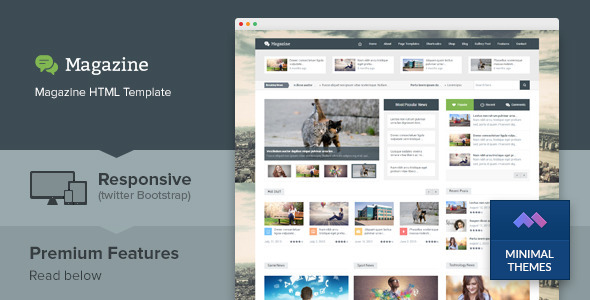
Magazine is a multipurpose HTML template built for news, magazine and blog websites, sold on ThemeForest by the developer minimalthemes for $19. It ships with more than 30 static page layouts, a Bootstrap grid, a working contact form and a set of custom widgets, and it is aimed at freelancers and small agencies who want a finished front end they can either deploy as-is or convert into a content management system of their own choosing. Anyone evaluating a Magazine business site build will find it a cheap, flexible starting point rather than a complete publishing platform.
What the template actually gives a Magazine business site
The core of the package is volume. There are over 30 page templates, and they fall into three rough groups. Editorial layouts cover a homepage, a second homepage variant, single post, blog, blog left and right sidebars, archive, gallery pages in two, three and four column arrangements, and a full-width page. Commerce layouts cover a shop listing, a product detail page, cart, checkout and order confirmation. Utility and demo pages include contact, about, author, sitemap, 404 and a long list of element showcases such as accordions, tabs, buttons, tables, columns, drop caps, blockquotes, headings and warning boxes. For a Magazine business that needs to publish quickly, that spread means most of the page types a reader will ever land on already exist as markup.
Several features are worth calling out because they change what the site can do rather than just how it looks. The news ticker and headline news blocks give a homepage the sense of constant updating that news readers expect, and they are the kind of element that usually has to be hand-built. The responsive slide menu handles navigation on small screens, which matters because magazine sites carry deep category structures that collapse badly if the menu is an afterthought. A rating system and social share buttons are wired in, so posts can carry engagement controls without extra plugins. Google Fonts and Google Maps integration are prepared, meaning typography and a location block can be swapped without touching the layout code.
Five custom widgets extend the same idea: a gallery box, recent posts filtered by category, tabbed content, a social media block and a Twitter updates feed. The category-filtered recent posts widget is the most practically useful of these, since it lets a section surface its own latest stories instead of showing the same global feed everywhere.
The markup is valid HTML5 and CSS3, and the vendor describes it as semantic and SEO friendly. That claim is worth treating with the usual caution — clean markup helps, but ranking depends on content, links and speed — yet starting from semantic structure is genuinely better than starting from a table-based layout. The template also uses Flexslider, BXSlider, prettyPhoto, TouchSwipe, jPages and idTabs for its interactive pieces, all of which are established libraries rather than bespoke code.
Where this template fits, and where it does not
The strongest fit is a publisher, blogger or small editorial team that wants a static or hand-coded site and needs a complete set of page designs on day one. A freelance developer building a news site for a local outlet, a niche blog with a shop attached, or an online magazine with sponsored content is squarely in the target audience. The bundled shop, cart and checkout pages also make it a reasonable choice for a publication that sells merchandise or subscriptions alongside its articles.
It also suits agencies that want a starting point for a custom CMS build. The vendor explicitly frames it that way: the template can be used as-is or developed into a system of the buyer’s own preference. Because the layouts are plain HTML, a team converting them into WordPress, Craft, Statamic or a custom PHP application is working with predictable markup rather than fighting a framework.
It is the wrong choice for anyone who needs a working content management system out of the box. There is no admin panel, no database and no publishing workflow here — the buyer gets pages, not a platform. It is also a poor fit for a site that expects frequent structural redesigns, since a static template means every layout change is a code change. And a project with strict accessibility or performance budgets should budget time to audit the bundled scripts, because the listing does not state any accessibility conformance or performance figures.
Setting it up in practice
Installation is a file copy. The buyer downloads the package, unzips it, and opens the HTML files in an editor or a local server. There is no installer, no build step and no dependency manager, so the only real prerequisite is a text editor and enough HTML and CSS knowledge to edit content directly. A local development server such as XAMPP, MAMP or a simple static server is helpful because the contact form and several of the JavaScript components behave better when served over HTTP rather than opened from the file system.
The first practical task is replacing the demo content. The vendor notes that all images on the demo site are for demonstration only and that the package ships with image placeholders instead, so every visual slot has to be filled with licensed assets. After that comes the contact form, which is built in but will need to be pointed at a mail handler or form service before it does anything. Google Maps and Google Fonts need API keys or configuration depending on how the buyer implements them, and the Twitter updates widget depends on a feed source that may need adjusting.
A single developer familiar with Bootstrap can have a homepage live in an afternoon. A full site — all sections, the shop pages, the forms and the widget areas — is realistically a few days of work, more if the content is being migrated from an existing site. The template was last updated in May 2016, so buyers should expect to spend some time checking that the bundled JavaScript libraries still behave as intended against current browsers.
Strengths and limitations
Strengths
- More than 30 page templates covering editorial, commerce and utility needs, which removes most of the layout work from a magazine build.
- News-specific components such as the ticker, headline news block and slider are included rather than left to the buyer.
- Clean, semantic HTML5 and CSS3 markup that is straightforward to convert into a CMS theme.
- Five custom widgets, including category-filtered recent posts, that add editorial flexibility without extra tooling.
- A low one-time price of $19, with an extended license available at $330 for buyers who need it.
- 455 sales on ThemeForest indicate a reasonably established product with a track record.
Limitations
- The last vendor update was in May 2016. Any buyer should verify that the bundled libraries still render correctly in current browsers before committing.
- There is no CMS, admin interface or database layer. Every content change is a manual file edit unless the buyer builds that layer themselves.
- The demo images are not included. All photography has to be sourced and licensed separately, which is a real cost that the $19 price does not cover.
- The bundled shop, cart and checkout pages are presentation only. There is no payment processing or inventory logic behind them.
- Dependency on multiple third-party scripts — Flexslider, BXSlider, prettyPhoto, jPages and others — means more surface area to audit and update over time.
How it compares with the wider category
Multipurpose HTML templates sit between two alternatives. On one side are full CMS themes, which cost more but arrive with an admin panel, content types and a publishing workflow already built. On the other are bare frameworks such as Bootstrap itself, which are free but leave every layout decision to the developer. This template occupies the middle: it is cheaper and faster than building from a framework, and more flexible than a CMS theme, but it hands the buyer none of the infrastructure a CMS provides.
Within the multipurpose HTML category, the differentiator is usually breadth and currency. This package is strong on breadth — the page count and the news-specific blocks are above what many comparable templates offer — and weak on currency, given the 2016 update date. A buyer comparing options should weigh how much of the site will be hand-coded against how much needs to be editable by non-technical staff. If the answer is mostly hand-coded, the breadth wins. If editors need to publish daily without developer involvement, a CMS-based alternative is the more sensible route regardless of price.
Frequently Asked Questions
Is Magazine a WordPress theme?
No. Magazine is a static HTML template, not a WordPress theme. It provides HTML, CSS and JavaScript files that can be opened in a browser or converted into a theme for WordPress or another CMS. Buyers who want a ready-made WordPress site should look at a dedicated theme instead, since this package includes no PHP templates or CMS integration.
Can the shop and checkout pages process real payments?
No, they are layout mockups only. The shop, product detail, cart, checkout and order pages give the visual structure of a storefront, but there is no payment gateway, cart logic or inventory system behind them. A buyer wanting a functioning store would need to connect those pages to an ecommerce platform or build the logic separately.
Does the $19 price include the images shown in the demo?
No. The vendor states that all images on the demo site are for demonstration purposes only, and the package ships with image placeholders instead. Every photograph and graphic has to be sourced and licensed by the buyer, which adds a cost that is not reflected in the template price.
Is the template still supported and updated?
The vendor offers lifetime updates and support through a ticket system, but the most recent update recorded on the listing is from May 2016. Buyers should treat ongoing maintenance as uncertain and plan to verify browser compatibility themselves. The support channel exists, but the age of the last release is the more useful signal.
Verdict
Magazine is a good buy for a freelancer or small agency that needs a complete set of news and magazine page layouts quickly and is comfortable working directly in HTML. The page count, the editorial components and the $19 price make it an efficient starting point, and 455 sales suggest it has served that audience reasonably well. It is not a fit for anyone who needs a CMS, a working store or a template that is actively maintained on a current release cycle. Buyers should go in expecting to handle content entry, image licensing and browser testing themselves, and should treat the 2016 update date as the main risk to weigh against the low price.