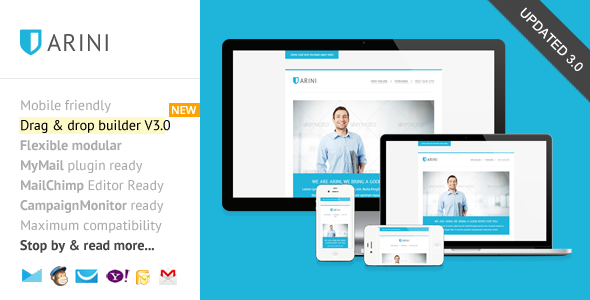
Arini, Responsive Newsletter with Template Builder is a commercial email template package sold on ThemeForest for $19, built for businesses that want a polished newsletter design without commissioning custom HTML. It ships five ready-made HTML files covering MailChimp, Campaign Monitor, the MyMail WordPress plugin and a plain HTML version, plus a drag-and-drop browser editor for assembling new layouts. Small businesses, freelancers and agencies running regular email campaigns are the natural buyers.
The item was created by saputrad and has been purchased 499 times, which places it in the modest-but-established range for this category. The most recent update landed in April 2015, a detail that matters more than the price tag for anyone evaluating it now.
What Arini, Responsive Newsletter with Template Builder actually includes
The download package is structured around five HTML files rather than a single generic template. One is written for MailChimp, one for Campaign Monitor, two are built for the MyMail WordPress plugin, and one is a standalone HTML file that can be dropped into almost any sending platform. Each layout also comes with its own image folder, so the assets travel with the code instead of being referenced from a remote host.
A sliced PSD file is included alongside the HTML. That gives a designer the layered source artwork to modify before exporting new graphics, which is unusual at this price point and useful for anyone who needs to swap in branded imagery rather than accept the stock visuals as they are.
Drag-and-drop template builder
The headline feature is a browser-based editor that lets a user add, remove and rearrange modules without touching code. Colour schemes, text and images can all be edited inside the tool, and the finished layout downloads as a zip containing the HTML and its image files. The vendor describes this as free access included with the purchase rather than a separate subscription, and the builder was revised in the version 3.0 release.
Thirteen modular blocks
The template is assembled from thirteen repeatable modules. In practice this means a header, content sections, button blocks and footer elements can be recombined into different layouts while the underlying code keeps working. The HTML carries comment markers around each block, so someone comfortable editing markup can copy a section, paste it elsewhere and adjust the content without breaking the surrounding structure.
Platform-specific editing
For MailChimp and Campaign Monitor users, the modules can also be manipulated inside those platforms’ own editors. Blocks can be added, removed, moved or hidden, and the theme colour can be set from within MailChimp directly. That matters because it means a marketer can make routine changes after handover without returning to the original HTML.
Client compatibility and mobile rendering
The vendor lists testing across a wide spread of inboxes, including Outlook 2003 through 2013, Apple Mail, Gmail, Yahoo Mail, Windows Live Mail, Lotus Notes 8 and 8.5, Mozilla Thunderbird, AOL Mail and the iPhone and iPad mail apps. Both direct device testing and an inbox inspection tool were used. The template relies on media query CSS for mobile layouts and keeps graphic elements deliberately light so the email loads quickly — a sensible decision given how many clients still throttle images by default.
Where this template fits and where it does not
The strongest fit is a small business or solo operator that sends a regular newsletter and wants something more considered than a stock platform template, but does not want to pay a developer to build one from scratch. A single purchase covers MailChimp, Campaign Monitor and MyMail, so an agency managing clients across more than one platform gets several usable starting points for one fee.
It also suits a WordPress site already running the MyMail plugin, since two of the five HTML files are written specifically for that environment and the setup documentation covers the upload process end to end.
Freelancers who occasionally need a newsletter for a client project are another reasonable audience. The PSD plus the modular HTML means a design can be adapted to a client’s brand colours and logo without rebuilding the table structure that keeps email rendering consistent.
Where it is the wrong choice: anyone whose brand depends on a highly custom layout with unusual interactive elements. Email templates of this type are built on nested tables and inline CSS because that is what email clients understand, and the modular approach here trades layout freedom for reliability. A team that needs bespoke animation, AMP for Email, or a design that departs significantly from a standard newsletter grid will spend more time fighting the structure than building on it. The same applies to anyone who needs a template maintained against current accessibility standards — nothing in the listing addresses that.
Setting it up in practice
No coding is required for the standard path. The buyer downloads a zip, opens the template builder in a browser, adjusts colours and content, and exports a new zip. From there the process depends on the platform.
- For MailChimp, the HTML file is uploaded as a custom template through the account’s template section, then modules are adjusted inside MailChimp’s editor.
- For Campaign Monitor, the same upload step applies, with blocks added or removed afterwards.
- For MyMail, the template is imported into the WordPress plugin and the theme colour set from the editor.
The vendor supplies written documentation and video walkthroughs covering the PSD file, the HTML file, sending through MailChimp, GetResponse, Campaign Monitor, AWeber and MyMail, and creating custom buttons with inline CSS. Realistically, a first-time setup takes somewhere between thirty minutes and an hour: uploading the template is quick, but matching brand colours and replacing placeholder content across several modules is the part that consumes time. Prerequisites are minimal — a MailChimp, Campaign Monitor or MyMail account, a browser, and image editing software if the PSD is going to be used.
Strengths and limitations
Strengths
- Five HTML files in one purchase, covering three sending platforms plus a generic version, which is generous for the price.
- The drag-and-drop builder removes the need to edit HTML for routine changes.
- Comment markers in the code make manual block duplication and removal straightforward for anyone who does edit markup.
- Sliced PSD included, so branding can be changed at the source rather than patched afterwards.
- Documentation covers the full path from PSD to live send, including video, which is more than many templates at this price provide.
- Light graphics and media query CSS support fast loading and mobile rendering.
Limitations
- The last vendor update was April 2015. Email client behaviour has changed considerably since then, and there is no indication of ongoing maintenance. Outlook rendering in particular has moved on, and newer clients are not covered by the listed test matrix.
- The compatibility list names iPhone 3, 4 and 5 and Android 4.1.2 as test devices. Those are historical references, not current coverage.
- There is no mention of accessibility features such as semantic headings, sufficient colour contrast or screen-reader-friendly markup.
- The listing does not state whether the template builder is hosted by the vendor or bundled locally, which is a practical concern if the service is ever discontinued.
- No dark mode support is referenced, and no AMP for Email variant is offered.
- Custom buttons require inline CSS written by hand, so the no-code promise has a boundary.
How it compares with the wider email template category
Commercial email templates generally fall into two groups: static HTML files that a buyer edits manually, and subscription services that host a builder and charge monthly. Arini sits between them. It is a one-time purchase that includes a browser builder, which is unusual — most products at this price are static files with documentation and nothing more.
Against static templates, Arini offers more: multiple platform-specific files, a PSD, and a visual editor. Against hosted builder services, it offers less flexibility and no ongoing updates, but no recurring cost and no dependency on a third-party platform staying in business. The trade-off is maintenance. A subscription service updates its templates as email clients change; a one-time purchase from 2015 does not.
For a buyer comparing on capability rather than brand, the question is whether the layouts work in the inboxes that matter for a specific audience. The vendor’s own testing suggests broad coverage at the time of release, but that evidence is now dated.
Frequently Asked Questions
Does Arini work with MailChimp?
Yes. One of the five HTML files is built specifically for MailChimp, and it can be uploaded as a custom template through the account’s template section. Once installed, modules can be added, removed, moved or hidden using MailChimp’s own editor, and the theme colour can be changed there directly.
Do I need to know how to code to use this template?
No, for the standard workflow. The included drag-and-drop builder handles layout arrangement, colour changes and content editing in a browser, and the finished template downloads as a zip. Hand-editing HTML is only necessary if custom buttons or structural changes beyond the builder’s options are required.
Is Arini still updated and supported?
The vendor’s most recent listed update is version 3.0 from April 2015. The listing describes ongoing support and detailed documentation, but no newer releases appear in the published update history. Buyers should assume the code reflects email standards as they stood at that time rather than current practice.
What files are included in the download?
The package contains five HTML files — one each for MailChimp, Campaign Monitor, two for the MyMail WordPress plugin, and one generic version — plus a sliced PSD file, image folders for each layout and colour variation, and help documentation that includes video tutorials covering setup and sending.
Verdict
Arini, Responsive Newsletter with Template Builder is a reasonable purchase for a small business, freelancer or agency that needs a working newsletter template across MailChimp, Campaign Monitor or MyMail and wants to avoid a monthly builder subscription. The five-file package, the PSD and the included visual editor represent solid value at $19, and the documentation is thorough enough to get a non-technical user from download to first send.
It is not the right choice for anyone who needs a template maintained against current email client behaviour, accessibility standards or modern rendering features such as dark mode and AMP. The 2015 update date is the deciding factor: if the project depends on the template working reliably in whatever inboxes appear next year, a maintained alternative is the safer route. If the requirement is a clean, responsive newsletter that can be adapted once and used for straightforward campaigns, this remains a workable option.
.__large_preview.png)