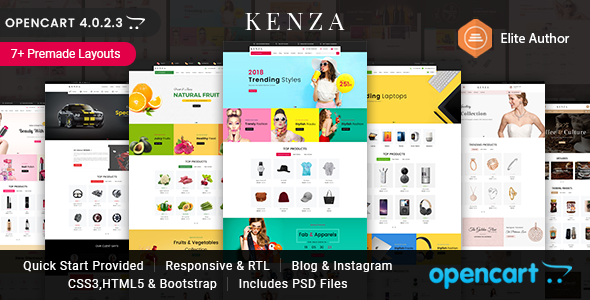
Kenza is a responsive OpenCart theme built for fashion, accessories and general merchandise stores, sold on ThemeForest for $27 by the developer ishithemes. It ships with a homepage builder, a vertical mega menu, Ajax cart behaviour and a set of product sliders, and it targets store owners who want a ready-made storefront rather than a custom design. Anyone running OpenCart 3.0.3.8 or the 4.0.2.x branch and looking for a low-cost Kenza Ecommerce starting point is the natural buyer here.
What Kenza Ecommerce Actually Delivers Out of the Box
The theme’s value sits less in any single feature and more in how much storefront furniture arrives pre-built. A merchant installing Kenza gets a homepage assembled from modular blocks: banner areas, brand logos, and four separate product carousels that can each pull a different product group — featured items, new arrivals, specials and best sellers. That means a store can look populated on day one without writing template code or commissioning a designer.
Navigation is handled by a vertical menu that can stay pinned to the top of the viewport while the visitor scrolls, which matters on category-heavy shops where a shopper browsing dresses should not have to scroll back up to reach shoes. The menu supports multiple levels, and the theme includes right-to-left language support, so Arabic, Hebrew and Farsi storefronts do not need a separate build.
Several features target friction at the point of purchase. The Ajax cart adds items without a page reload, a cart dropdown in the header shows the running total at all times, and quick view opens a product’s key details in an overlay so shoppers can add to cart without leaving the category page. Product pages support zoom, and the catalogue can be displayed as either a grid or a list — a small thing, but useful for stores selling items where customers compare specifications rather than browse visually.
The technical layer is conventional but sound. Markup is HTML5 and CSS3 on a Bootstrap grid, the CSS is retina-ready for high-density screens, and the vendor states there are no JavaScript conflicts and no core file modifications. That last point is worth flagging: because Kenza overrides OpenCart through the theme layer rather than editing core files, OpenCart version upgrades are less likely to break the storefront. The theme is also documented, includes PSD source files for the design, and the vendor lists SEO-friendly markup and load-time optimisation among its features — though no specific performance figures are published.
Beyond the storefront, there is a blog module for content marketing, a scroll-to-top control, and extra link blocks in the footer for policy pages, social profiles or secondary navigation. Multiple currencies and languages are supported, which is standard for OpenCart but worth confirming for cross-border sellers.
Where Kenza Fits and Where It Does Not
The strongest fit is a small or mid-sized fashion, footwear, jewellery, watch or bag retailer that already runs OpenCart and needs a presentable storefront quickly. The demo layouts lean heavily toward apparel and accessories, and the homepage block structure suits a shop with a moderate catalogue — enough products to fill four carousels, not so many that merchandising becomes a full-time job.
It also suits agencies and freelancers delivering a fixed-scope store on a tight budget. At $27, the theme cost is negligible against build time, and the PSD files give a designer something to work from if the client wants palette or typography changes without rebuilding layouts from scratch. Multipurpose stores selling electronics, gifts or food are plausible users too, since the vendor tags cover those categories, but the default styling will need more adjustment to stop looking like a clothing shop.
Where Kenza is the wrong choice: a store that needs a highly bespoke shopping experience. If the project requires custom checkout flows, subscription logic, complex product configurators or a headless front end, a $27 theme is the wrong foundation and the money saved will be spent many times over on developer hours working around it. Stores on OpenCart versions outside the supported list — the vendor names 3.0.3.8, 4.0.2.1 and 4.0.2.3 — should also look elsewhere or budget for compatibility work, because the vendor does not claim support beyond those releases.
What Installation and Setup Involves
Kenza assumes a working OpenCart installation already exists. The theme is not a hosted platform and does not include hosting, so a buyer needs a server with PHP and MySQL, an OpenCart install on one of the supported versions, and admin access to that install. The vendor describes installation as easy and provides documentation, and because the theme makes no core modifications, the process is the standard OpenCart route: upload the theme package, activate it, then import or configure the demo content if a starting layout is wanted.
Realistically, a competent developer can have the theme installed and the homepage blocks populated in an afternoon. The longer work is everything after that: replacing demo imagery with real product photography, setting up categories and attributes, configuring shipping and payment extensions, and adjusting colours and fonts to match a brand. For a store with a few hundred products, expect the full setup — theme plus catalogue plus payment and shipping configuration — to run across several days rather than hours. The vendor notes that the demo should be matched using the latest theme version, since older versions differ in design and features.
Strengths and Limitations
Strengths
- Broad feature coverage for the price: Ajax cart, quick view, product zoom, grid and list views, blog module and multiple homepage sliders all ship in the base package.
- No core file modifications, which keeps future OpenCart updates less risky than themes that patch core code.
- RTL language support and multi-currency handling make it usable for non-English storefronts without a separate theme.
- PSD files included, so design changes do not require reverse-engineering the layout.
- Established track record: 305 sales on ThemeForest, which suggests the theme has been through real deployments rather than sitting untested.
Limitations
- OpenCart version support is narrow. The vendor lists only 3.0.3.8, 4.0.2.1 and 4.0.2.3, so stores on other releases have no stated compatibility guarantee.
- The last vendor update was December 2023. That is not abandoned, but it is not an actively iterated theme either, and newer OpenCart releases may not be covered.
- The default design is heavily fashion-oriented. Stores in other verticals will need meaningful styling work to avoid looking like an apparel shop.
- No published performance benchmarks. The listing claims quick load times but provides no measured figures, so buyers should test on their own hosting.
- Support quality is described only as “quick support” with no stated response times or support period, which is a gap for anyone planning a long build.
How Kenza Compares to Other OpenCart Themes
The OpenCart theme market splits roughly into three tiers: free themes bundled with extensions, mid-range commercial themes in the $20 to $60 band, and premium themes above that with dedicated support contracts and frequent release cycles. Kenza sits firmly in the middle tier, and it competes on breadth rather than depth — the feature list is long for the price, but each feature is implemented in a conventional way rather than a distinctive one.
Against free themes, the case is straightforward: Kenza offers a coherent design system, documented setup and PSD files that free themes rarely match, and the absence of core modifications is a genuine structural advantage over many budget options. Against premium themes, the trade-off runs the other way. A higher-priced theme typically buys more frequent updates, a defined support window and broader OpenCart version coverage — the exact areas where Kenza is thinnest. Buyers weighing the two should decide whether they are optimising for upfront cost or for long-term maintenance, because Kenza clearly favours the former.
For merchants comparing multipurpose themes generally, the deciding question is catalogue shape. Kenza’s homepage is built around product carousels and banner blocks, which flatter visual retail. Themes designed around comparison tables or specification-heavy listings will serve electronics and industrial catalogues better, even if Kenza technically supports those categories.
Frequently Asked Questions
Which OpenCart versions does Kenza support?
The vendor lists OpenCart 3.0.3.8, 4.0.2.1 and 4.0.2.3 as supported versions. No other releases are named, so stores running earlier 3.x builds or newer 4.x releases should confirm compatibility before buying. The vendor also advises installing the latest theme version to match the demo, since older theme builds differ in design and features.
Does Kenza require coding to set up?
No coding is required for a standard setup. The theme installs through the OpenCart admin panel, and the homepage is assembled from pre-built blocks and modules that are configured through settings rather than code. Custom layout changes, new modules or deep styling work would need a developer, but a basic storefront can be configured without one.
Is Kenza suitable for stores outside fashion and clothing?
It can work, but the default design is clearly aimed at fashion and accessories. The vendor tags cover electronics, food, gifts and general merchandise, and the layout blocks are generic enough to repurpose. Stores in those categories should expect to invest in colour, typography and imagery changes to avoid an apparel-store look.
Does Kenza support multiple languages and currencies?
Yes. The theme supports multiple languages and currencies, and it includes right-to-left language support for scripts such as Arabic, Hebrew and Farsi. Language and currency switching is handled through OpenCart’s own localisation settings rather than a separate theme mechanism, so stores already configured for multiple markets can enable it without extra work.
Verdict
Kenza is a sensible purchase for a small fashion, accessory or general retail store already running a supported OpenCart version, where the goal is a competent storefront at minimal cost. It is also a reasonable pick for freelancers and agencies who need a dependable base for fixed-budget client builds. It is not the right choice for merchants on unsupported OpenCart releases, for stores needing bespoke checkout or catalogue logic, or for anyone who expects frequent theme updates and a defined support contract. At $27 with 305 sales behind it, the risk is low and the ceiling is modest — which is exactly what this tier of theme is for.