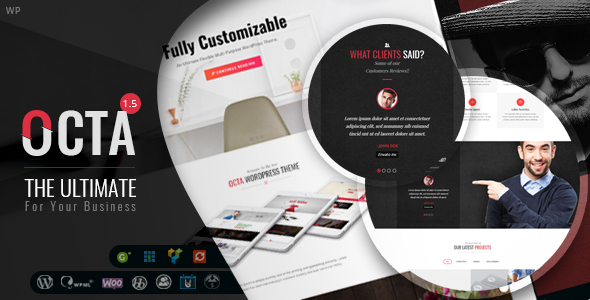
OCTA is a multipurpose WordPress theme sold on ThemeForest for $49, built by WinsomeThemes for creative companies, agencies and freelancers that need to present work, explain services and sell products from one site. It ships with a drag-and-drop page builder, a slider plugin, a portfolio plugin and pricing tables bundled into the purchase price, and it supports WooCommerce, bbPress and BuddyPress out of the box. It suits small studios and independent professionals who want a broad design toolkit without assembling a stack of separate plugins, and it is a weaker fit for anyone who needs a lean, fast-loading site with minimal code overhead.
What OCTA corporate buyers actually get in the box
The headline value here is bundled software. A drag-and-drop page builder, Slider Revolution and a pricing table plugin are all included, and the vendor puts the combined saving at $73 against buying those tools separately. For a freelancer quoting a fixed-price build, that changes the maths on a project. The theme also bundles its own portfolio plugin, so project galleries are handled by the theme rather than a third-party add-on.
Layout range is unusually wide for the price. There are 24 prebuilt home page variations, five header styles, seven footer styles and four one-page designs. Blog output can be presented five ways — large image, small image, timeline, masonry or grid — each with a left, right or no sidebar. Contact pages come in four arrangements, and there are three styles each for 404 and coming-soon screens. Anyone who has built a corporate site knows that the contact page and the 404 page are usually the two that get neglected; having styled options ready saves an afternoon.
Page-level control is where the theme separates itself from simpler multipurpose products. Individual pages can be assigned their own menu, their own title treatment with a custom image or video background, and their own option set. That matters on a corporate site where the homepage, a campaign landing page and a careers page often need to behave differently. A super mega menu is supported for sites with deep navigation.
Ecommerce and community features are covered without extra purchases. WooCommerce runs with a custom sidebar, bbPress forums get a custom welcome message, and BuddyPress gets its own sidebar treatment. Contact Form 7 and Yoast SEO are both supported. RTL support is included, which opens the theme up to right-to-left language markets.
Smaller touches round out the package: parallax backgrounds, page transitions, six icon font sets, more than 730 Google Fonts, custom widgets for tweets, Flickr, contact details and social icons, and a one-click demo importer that populates the site with sample content.
Where an OCTA corporate build makes sense, and where it does not
The strongest fit is a small agency or design studio building its own site or a client site with a moderate page count. The combination of portfolio, blog, pricing tables and a page builder covers the typical agency requirement — show work, publish thinking, quote services — without a plugin shopping list.
Freelancers selling a service or a small product line are the second natural audience. WooCommerce support means a single-product or small-catalogue shop sits inside the same theme as the portfolio, which keeps the build simple.
Organisations that need a forum or a membership community alongside a corporate front end are also well served, since bbPress and BuddyPress are both pre-styled rather than bolted on.
The wrong choice is a content-heavy publisher or a site where performance is the primary constraint. A theme that bundles a page builder, a slider and a pricing plugin loads more CSS and JavaScript than a hand-coded or block-based theme would. A news site with thousands of posts, or a company measuring Core Web Vitals closely, will find that overhead harder to justify. The same applies to a team already standardised on the WordPress block editor — OCTA’s builder is a separate editing paradigm, and mixing the two across a site creates maintenance friction.
Setting up OCTA in practice
Installation follows the normal WordPress route: upload the theme, activate it, then run the one-click demo importer if a starting point is wanted. The importer pulls in demo pages, menus and widget areas, which is the fastest way to see how the theme is structured. Note that importing demo content on a live site will overwrite existing content, so it belongs on a fresh install.
The bundled plugins — the page builder, Slider Revolution, the pricing table plugin and the theme’s own core and portfolio plugins — need to be installed and activated after the theme. The vendor’s own documentation walks through this step by step.
Prerequisites are modest: a standard WordPress installation, a host running a PHP version the theme supports, and the usual plugin licences if Yoast or Contact Form 7 are wanted. The vendor’s release log shows compatibility work through WordPress 5.x and PHP 7.x, with the most recent entry dated January 2024, but the vendor does not state support for PHP 8.x or the current WordPress release, so that is worth confirming before purchase if the host runs newer versions.
A realistic timeline for a competent WordPress developer is a day to get a homepage, an inner page, a portfolio and a contact page in place using the demo content as a scaffold. A full agency site with custom layouts, a shop and a blog is a week of focused work. Non-technical owners should budget longer, or hand the build to a developer.
Strengths and limitations
Strengths
- Four premium plugins bundled at no extra cost, which removes roughly $73 of separate licence spend on a client project.
- Genuinely broad layout coverage: 24 home pages, multiple header, footer, blog and contact arrangements, plus four one-page designs.
- Per-page menus and per-page options give real control over campaign and landing pages without custom code.
- WooCommerce, bbPress and BuddyPress are all pre-styled, so community and shop features do not require design work from scratch.
- One-click demo import shortens the gap between purchase and a working site.
- 335 sales and a long, documented release history back the claim that the theme is maintained rather than abandoned.
Limitations
- The bundled page builder, slider and pricing plugins add page weight. Sites where loading speed is a hard requirement will need to strip features back or accept the overhead.
- The most recent changelog entry is from January 2024, and the vendor does not state compatibility with PHP 8.x or recent WordPress releases. Buyers on modern hosting stacks should verify this first.
- Editing happens in the theme’s own builder rather than the WordPress block editor, which creates a split workflow on sites that also use core blocks.
- With 335 sales, the theme has a smaller user base than the category leaders, so community answers and third-party tutorials are thinner on the ground.
- Support and update terms are governed by the ThemeForest licence and are not specified in the listing itself.
How OCTA compares with other multipurpose corporate themes
The multipurpose corporate category splits roughly into two camps. One group sells a single flexible theme with a page builder and expects buyers to add their own slider, shop and community plugins. The other bundles everything into one purchase price, which is where OCTA sits.
Against the first group, OCTA wins on upfront cost and on the speed of getting a complete site running, because the slider, pricing tables and portfolio are already integrated and styled to match. It loses on leanness — a buyer who only needs a five-page brochure site is paying in page weight for features they will never switch on.
Against other bundled multipurpose themes, the differentiators are narrower. OCTA’s per-page menu assignment and per-page option panels are more granular than many competitors offer, and the 24 home page variations are a large number at this price point. What it does not offer is the block-based, full-site-editing approach that newer themes are built around, and that is the main axis on which a buyer should choose between OCTA and a modern alternative. The decision comes down to whether a familiar builder workflow and bundled plugins are worth more than a lighter, block-native foundation.
Frequently Asked Questions
Is OCTA compatible with the latest version of WordPress?
The vendor’s most recent changelog entry, dated January 2024, does not state compatibility with the current WordPress release or with PHP 8.x. Earlier entries confirm support through WordPress 5.x and PHP 7.x. Buyers on modern hosting should confirm current compatibility with the developer before purchase, since the listing does not say.
Does OCTA include WooCommerce and can it run an online shop?
Yes. OCTA is WooCommerce-ready and includes a custom sidebar for shop pages, and the release log shows repeated updates for WooCommerce compatibility. That makes it suitable for a small product catalogue sold alongside a portfolio or service offering. Large, complex stores with heavy customisation needs may still prefer a dedicated ecommerce theme.
What plugins come bundled with the OCTA theme?
The purchase includes a drag-and-drop page builder, Slider Revolution, a responsive pricing tables plugin and the theme’s own portfolio and core plugins. The vendor values the bundled extras at $73 in combined savings. These are installed and activated separately after the theme itself, and the included documentation covers the sequence.
Can OCTA be used for a forum or membership community?
Yes. The theme is bbPress-ready with a custom welcome message and BuddyPress-ready with its own sidebar styling, so a forum or social community can sit inside the same site as the corporate pages. Both integrations are pre-styled, which removes the design work normally needed to make community plugins match a theme.
Verdict
OCTA is a sensible purchase for a freelancer or small agency that wants one theme covering a corporate site, a portfolio, a blog, a small shop and possibly a forum, and that values bundled plugins over a minimal footprint. The breadth of layouts and the per-page control options justify the $49 for that buyer. It is the wrong choice for performance-sensitive publishers, for teams committed to the WordPress block editor, and for anyone who needs confirmed compatibility with the newest PHP and WordPress releases before committing. The 335 sales and steady release history suggest a maintained product rather than an abandoned one, but the smaller user base means less community support when something goes wrong.