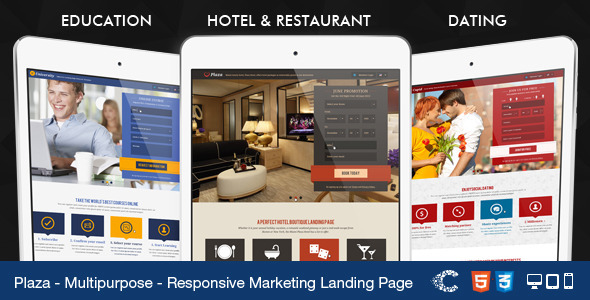
Plaza is a Bootstrap-based HTML landing page template sold on ThemeForest for $23, and it bundles three separate one-page designs aimed at education, hotel and dating businesses. It is a static template rather than a WordPress theme, so it suits freelancers, agencies and small business owners who are comfortable editing HTML and CSS directly. With 453 sales and a long gap since its last vendor update in July 2015, it occupies a specific niche: buyers who want a cheap, fast, hand-coded landing page and do not need a content management system behind it.
What the Plaza template actually gives a buyer
The headline feature is that one purchase covers three distinct landing page designs. Each is a single-page layout, which means navigation happens through anchor links that scroll down the page rather than loading separate URLs. For a campaign page, a hotel booking pitch or a dating sign-up funnel, that structure keeps visitors on one screen and pushes them toward a form.
The template is built on Bootstrap, the widely used front-end framework that supplies a grid system and pre-built interface components. In practice this means the layout is assembled from reusable blocks of markup, so sections can be reordered or removed without rewriting the underlying stylesheet. The vendor explicitly markets this rearrangement workflow, and it is the main reason a non-designer can produce a custom page in an afternoon.
Responsiveness is handled by that same grid, so the three designs reflow across desktop, tablet and phone widths. Colour changes and Google Font substitutions are exposed through the stylesheet, and the listing mentions more than 30 background patterns plus three colour variants per design. Newsletter sign-up forms, pricing tables and testimonial blocks are all included as ready-made sections, which covers the components most landing pages need.
Animation is the other notable capability. Plaza uses CSS3 transitions accelerated by the browser’s graphics hardware, and the effect for each element is chosen through a data attribute in the HTML rather than by writing new CSS. The vendor states there are more than 50 effects to pick from. That approach is genuinely convenient for anyone who wants scroll-triggered motion without touching a JavaScript file, though it also means the animations are decorative rather than functional.
Buyers also receive three layered Photoshop files, one per design, plus a PHP file for the newsletter form and a full HTML documentation page. The vendor values the PSDs at $10, which is a reasonable way to frame the bundle: the layered source lets a designer rebuild or extend the layout in Photoshop before returning to code.
Where Plaza fits, and where it does not
The three bundled designs map onto three clear use cases. A language school, tutoring service or online course provider can use the education layout to present a programme and capture enquiries. A boutique hotel, guesthouse or holiday rental can use the hotel layout to showcase rooms and drive reservation requests. A dating site or app can use the dating layout to explain the product and collect sign-ups. Outside those three verticals, the general business and marketing structure is loose enough to repurpose for a freelance portfolio, a photography studio or a small agency’s service page.
The template is also a sensible fit for agencies that build many small campaign pages and want a cheap starting point they can restyle per client. Because it is plain HTML and CSS, it can be dropped into almost any hosting environment without a database, and it will load quickly on shared hosting.
Where Plaza is the wrong choice is any project that needs a content management system. There is no WordPress integration, no admin panel and no way for a non-technical client to edit copy without opening a code editor. A business that expects to update prices, room availability or blog posts weekly should look at a CMS-based theme instead. The same applies to anyone who needs e-commerce checkout, multi-language routing or a booking engine with live availability, none of which a static template provides.
Setting up Plaza in practice
Installation is a file upload rather than a software installation. The buyer downloads a ZIP archive, extracts the HTML pages, the CSS, the JavaScript, the PHP form handler and the PSDs, then uploads the HTML folder to a web host via FTP or a control panel file manager. There is no build step, no package manager and no database to configure, which keeps the process short.
The one prerequisite that catches people out is the newsletter form. Because it is handled by a PHP file, it needs a server that runs PHP, and it needs to be pointed at a mail service or SMTP credentials before it will deliver anything. On static hosting platforms that do not execute PHP, that form will not work without being replaced by a third-party embed.
Customisation is where the real time goes. Swapping the demo text and images for real content is quick, but matching a brand palette and typography across three designs takes longer, and rewriting the anchor navigation means editing several sections at once. A realistic estimate for a single design, from upload to a live page with real copy and a working form, is roughly half a day for someone fluent in HTML and CSS, and one to two days for someone learning as they go. The included documentation covers the basics but, like most templates of this vintage, it explains the template rather than teaching the underlying code.
Strengths and limitations
Strengths
- Three complete landing page designs in a single $23 purchase, which is unusually good value for a multi-purpose template.
- Bootstrap foundation makes the markup predictable and easy to restructure for anyone who has used the framework before.
- Animation effects are controlled by data attributes, so motion can be added or removed without writing JavaScript.
- Layered PSD files are included, which matters if a designer needs to adapt the visuals before coding.
- Static HTML output means fast page loads and compatibility with almost any host, including cheap shared plans.
- 453 sales and a long presence on the marketplace give a reasonable signal that the code is stable in real deployments.
Limitations
- The last vendor update was in July 2015. The changelog shows Internet Explorer 8 support was dropped in April 2015, and nothing has been released since, so there is no evidence of maintenance for modern browser quirks or accessibility standards.
- There is no CMS, page builder or admin interface. Every text change requires editing HTML.
- The newsletter form depends on PHP, which rules it out on static hosting without modification.
- No e-commerce, booking or membership functionality is included, despite the hotel and dating positioning.
- Demo imagery is licensed to its original owners and cannot be reused, so buyers must source their own photography.
- The documentation is described only as an HTML page; the vendor does not state whether it covers troubleshooting or advanced customisation.
How Plaza compares with the wider landing page category
Landing page templates broadly split into three groups: static HTML templates like Plaza, CMS themes that plug into WordPress or a similar platform, and hosted page builders that charge a monthly subscription. Plaza competes on price and portability. At $23 as a one-off cost, it undercuts subscription builders within a couple of months, and unlike a CMS theme it carries no hosting requirements beyond a basic web server.
Against other static templates, the differentiator is the bundle. Most single-purchase landing templates ship one design; Plaza ships three, plus PSDs. That makes it competitive for agencies producing varied campaign pages. The trade-off is age. A template released in 2013 and last touched in 2015 will not include the accessibility features, modern CSS techniques or performance optimisations found in newer releases, and it will not have been tested against current browser versions by its author.
Against CMS-based options, Plaza loses on maintainability and wins on speed and simplicity. A WordPress landing page theme gives a client the ability to edit content themselves and typically receives ongoing updates. Plaza gives neither, but it also has no plugin conflicts, no database to secure and no update treadmill to manage. The right side of that trade depends entirely on who will maintain the page after launch.
Frequently Asked Questions
Is Plaza a WordPress theme?
No. Plaza is a static HTML and CSS template, not a WordPress theme. It cannot be installed through the WordPress dashboard and does not connect to a database. Anyone needing WordPress should look for a theme built for that platform, or expect to convert the Plaza markup into a custom theme manually, which is a development project in itself.
Can the Plaza newsletter form send emails without extra setup?
No. The included PHP file handles the form submission, but it still needs to be connected to a mail service or SMTP account before messages are delivered. The template also requires a host that executes PHP. On static hosting, the form must be replaced with a third-party sign-up embed from a service such as Mailchimp.
Does Plaza still work in current browsers?
The Bootstrap grid and CSS3 animations it relies on are still supported by modern browsers, so the core layouts should render correctly. However, the vendor has not released an update since July 2015, so no recent testing is documented. Buyers should check the demo in their target browsers and expect to patch any issues themselves.
Can Plaza be used for a hotel booking system?
Only as a marketing front end. Plaza provides a hotel-themed landing page with room presentation and a contact or enquiry form, but it has no booking engine, no availability calendar and no payment processing. A real reservation system would need to be integrated separately, either through a third-party widget or custom development.
Verdict
Plaza is a fair buy for a freelancer or small agency that needs a cheap, fast, hand-coded landing page and is comfortable working in HTML and CSS. The three-design bundle and the included PSDs justify the $23 for anyone who will reuse the files across multiple projects, and the Bootstrap foundation keeps customisation predictable. It is not suitable for a business that wants to edit its own content, needs booking or e-commerce functionality, or expects ongoing vendor updates and support. The 2015 update date is the deciding factor: treat Plaza as a stable but frozen codebase, and budget time to test and patch it rather than assuming it will work untouched.
.__large_preview.png)