SuperFine is a multi-purpose HTML5 template sold on ThemeForest for $15, aimed at corporate, agency and freelance sites that need a polished front end without a content management system. It ships as a static HTML/CSS package built on Bootstrap, with more than 230 pages, 20 home page variations and a large library of layout components. Buyers who want a ready-made design system they can hand to a developer, or edit directly, are the natural audience; anyone expecting a WordPress theme or a working online store should look elsewhere.
What the SuperFine corporate template actually gives you
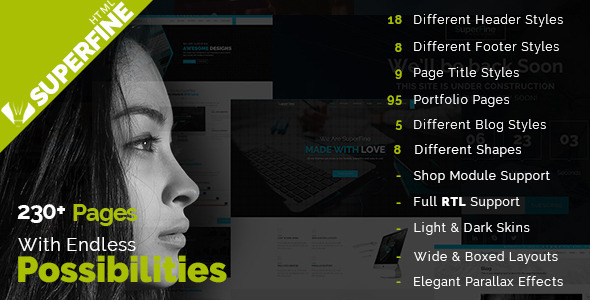
The headline number is page count. SuperFine includes over 230 HTML5 pages, and the vendor has organised them so that most of the work of building a corporate site is already done. There are more than 20 distinct home page designs, three one-page layouts with their own navigation behaviour, and 95 portfolio pages. For an agency pitching several client sites from one purchase, that breadth is the main argument for the price.
Layout flexibility is handled through a system of options rather than one fixed design. The SuperFine corporate package ships with 18 header layouts, eight footer layouts and nine page title styles, plus light and dark colour schemes, wide and boxed page widths, and eight shape treatments. Thirteen colour skins are pre-built and the styling is described as supporting unlimited colour variations. In practice this means a site can be re-skinned substantially without rewriting the CSS, which is the difference between a template that saves a week and one that saves an afternoon.
Content blocks cover the usual corporate requirements: five pricing table styles, five team member boxes, six accordion styles, ten tab styles, seven pager styles, four contact page layouts, two login layouts, and a mega menu. Media handling includes parallax backgrounds, full-screen video backgrounds, and four slider engines — Revolution Slider, Flex Slider, Camera Slider and OWL Slider. Revolution Slider is bundled and the vendor values it at $14, which is close to the entire cost of the template.
Two other details are worth flagging. The template is fully RTL (right-to-left) ready, so it can serve Arabic, Hebrew or Persian language sites without a separate build. It is also retina ready, meaning graphics are supplied at double resolution for high-density screens, and the vendor lists cross-browser support for IE9 through IE11, Firefox, Chrome, Opera and Safari.
Where SuperFine fits, and where it does not
The strongest fit is a small agency or freelancer producing a brochure-style corporate site on a short deadline. A consultancy, a medical practice, a restaurant, a creative studio or a small business that needs a services-and-portfolio presence can be assembled from the existing pages with colour and typography changes. The one-page layouts suit launch or event sites, and the coming soon page is a reasonable placeholder while content is being written.
It also suits projects where a developer will take over the markup. The code is described as clean and valid, built on Bootstrap, with step-by-step documentation. A front-end developer can strip the demo content and wire the pages into a custom back end or a static site generator without fighting the structure.
Where it does not fit is any project that needs a working CMS or a functioning shop. The vendor states plainly that the e-commerce styling is not functional, the blog styles are not functional, and the search box animation is not functional. Those are visual treatments only. A buyer who needs to publish posts, take payments or run a searchable catalogue will need to add that functionality themselves or choose a different product. The same applies to anyone who needs ongoing vendor updates: the last recorded update is November 2015, so the template should be treated as a finished artefact rather than a maintained platform.
Setting it up in practice
There is no installation process in the software sense. The purchase delivers a ZIP archive of HTML, CSS, JavaScript and image assets, which is unzipped and opened in an editor. From there the workflow is to duplicate the page that most closely matches the target layout, replace the demo text and images, and adjust the colour skin and layout options.
Prerequisites are modest: a code editor, an FTP client or hosting control panel for deployment, and enough HTML and CSS familiarity to edit markup confidently. No build tools, package manager or server-side runtime are required. The vendor includes step-by-step documentation, and the shortcode library means many components can be dropped in by copying a block of markup rather than writing it.
A realistic timeline for someone comfortable with HTML is one to three days for a five-page corporate site using existing layouts, and longer if the design needs to diverge from the supplied skins. A non-technical buyer should budget for a developer, because the demo images are not included in the download and every placeholder has to be replaced.
Strengths and limitations
Strengths
- Unusually deep page library for the price: 230+ pages, 20+ home pages and 95 portfolio pages cover most corporate content needs out of the box.
- Genuine layout variety through 18 headers, eight footers, light/dark schemes and boxed or wide widths, so multiple client sites can look distinct.
- Revolution Slider is bundled, which the vendor values at $14 against a $15 purchase price.
- Full RTL support and retina-ready assets extend the usable market beyond English-language, standard-density sites.
- Bootstrap foundation and documented structure make handover to a developer straightforward.
- 745 sales and a ThemeForest rating give a reasonable signal that the template has been used in the wild.
Limitations
- Several advertised features are explicitly non-functional: e-commerce styling, blog styles and the animated search box. They are design mock-ups, not working components.
- The last vendor update was 18 November 2015. Dependencies such as jQuery plugins and the Google Maps and Twitter integrations have not been refreshed since, and third-party APIs have changed considerably since then.
- Demo images are excluded from the download, so a buyer must source or license all photography separately.
- It is a static HTML template, not a theme. There is no admin panel, no database and no content editing interface.
- The volume of options — 18 headers, 13 skins, 20 home pages — creates a real selection cost before any work begins.
How it compares with other multi-purpose HTML templates
The multi-purpose HTML template category competes mainly on breadth and on how much of the design work is pre-decided. SuperFine’s advantage is the sheer number of finished pages and the granular layout options, which puts it ahead of thinner templates that offer one home page and a handful of inner pages. For a buyer comparing on raw material per dollar, it is competitive.
Where it falls behind is currency. Newer templates in the same category typically ship with updated JavaScript dependencies, modern CSS approaches such as flexbox or grid, and active support. SuperFine relies on Bootstrap-era conventions and a 2015 dependency set. A buyer weighing it against a newer alternative is effectively choosing between more pages and more current code.
Against WordPress themes specifically, the comparison is not close in either direction. A theme gives a working CMS with no coding; SuperFine gives full control over markup with no admin layer. The right choice depends entirely on whether the site owner intends to edit content themselves.
Frequently Asked Questions
Is SuperFine a WordPress theme?
No. SuperFine is a static HTML5 and CSS3 template, not a WordPress theme or plugin. It provides pre-built pages that are edited directly in a code editor and uploaded to hosting. There is no admin dashboard, database or content management system of any kind, so updating text means editing the HTML files themselves.
Does the SuperFine template include a working online store?
No. The vendor states that the e-commerce styling is not functional, meaning the shop pages are visual designs only. There is no cart, checkout, payment integration or product management. Anyone needing to sell online would have to build that functionality separately or choose a platform with commerce built in.
Is SuperFine still updated and supported?
The most recent vendor update recorded is 18 November 2015, which released version 1.1.1. No later releases are listed. The vendor advertises 24/7 customer support, but buyers should assume the codebase is frozen and that bundled third-party scripts and API integrations have not been maintained since that date.
How much does SuperFine cost and what is included?
SuperFine costs $15 as a one-time purchase on ThemeForest. The download includes over 230 HTML pages, 20-plus home page layouts, the Revolution Slider plugin, documentation and the full CSS and JavaScript assets. Demo photographs shown in the preview are not included, so images must be sourced separately.
Verdict
SuperFine is a sensible purchase for a freelancer or small agency that needs a corporate brochure site built quickly and is comfortable working in HTML. The page count, layout options and bundled slider deliver real value at $15, and the Bootstrap foundation keeps the code approachable for a developer. It is not the right choice for anyone who needs a CMS, a functioning shop or a blog that publishes without code edits, and the 2015 update date means it should be treated as a static asset rather than a maintained product. Buyers who need current dependencies or ongoing support should look at newer templates in the same category.