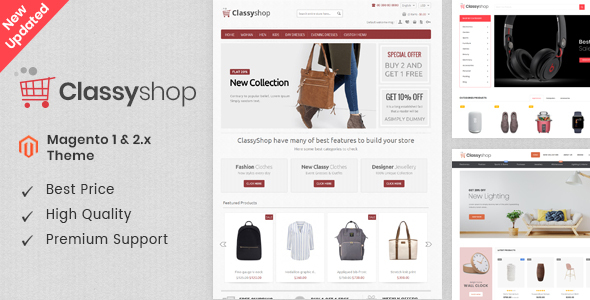
Classy Shop is a responsive Magento theme built by TemplateMela for apparel, clothing and fashion retail stores. It ships with a fluid product grid, mega menu, banner and slider management, Cloud Zoom image magnification and a set of merchandising modules that store owners control from the Magento admin. It suits shop owners running Magento 1.8, 1.9 or 2.2/2.3 who want a fashion-focused storefront without commissioning a custom design, and it sells for $49 on ThemeForest with 690 sales to date.
What the Classy Shop Ecommerce Template Actually Delivers
The theme’s centrepiece is a fluid product grid that reflows as the viewport narrows. On a phone the grid drops to fewer columns per row, and on a desktop it expands. For a clothing catalogue, where product photography carries most of the selling weight, that behaviour matters more than almost any other layout decision, because a grid that breaks awkwardly on a mid-size tablet makes the whole store look unfinished.
Merchandising is handled through admin-side modules rather than hard-coded template edits. Featured, bestseller and latest product blocks can each be positioned and configured without touching PHP, which means a store manager can promote a seasonal line or push slow-moving stock to the homepage without waiting on a developer. Brand logos get their own slider, also admin-controlled, so a multi-label shop can display supplier marks in a rotating strip.
Product pages include Cloud Zoom, which enlarges an image on hover or tap, plus previous/next navigation so a shopper can move through a category without returning to the grid. There is also a custom tab on the detail page, useful for size charts, fabric care notes or delivery terms — the kind of content apparel buyers look for before committing.
Navigation uses an advanced mega menu, and the header carries a dropdown shopping cart so the basket contents stay visible from any page. Both are standard expectations in fashion ecommerce, and their presence here means fewer third-party extensions to install and maintain.
On the technical side, the theme is built with HTML5 and CSS3, uses Google Fonts, supports multiple languages, and avoids core file modifications — a meaningful point, because a theme that leaves Magento’s core untouched is far easier to upgrade later. CSS sprites and general asset optimisation are applied for faster loading. The markup is described as valid XHTML and CSS, and the vendor states it is compatible with all major browsers. Full PSD source files and a user guide are bundled.
Where Classy Shop Fits and Where It Does Not
This is a sensible choice for a small or mid-size apparel retailer already committed to Magento and wanting a storefront that looks purpose-built for clothing rather than a generic catalogue. It also fits agencies delivering a fashion client site on a tight budget, since the PSD files and commented code give a designer room to restyle without rebuilding the template layer.
Multi-brand stockists benefit from the brand logo slider and mega menu, which together handle a deeper category tree than a simple top-level navigation bar can. Stores that sell in more than one language are also served, given the built-in multilingual support.
The wrong fit is anyone starting a new store today on Magento 2.4 or later. The vendor’s compatibility list stops at 2.3.x, and the most recent update was April 2019. Magento 2.4 introduced platform changes that older themes were not written against, and the vendor does not state support for it. A merchant on a current Magento release should look at themes with active maintenance rather than assume this one will install cleanly.
It is also a poor match for a store that needs heavy custom functionality — subscriptions, complex configurable pricing, or bespoke checkout flows. Those requirements sit outside a template’s scope regardless of which theme is chosen.
What Setup Involves
Installation follows the standard Magento theme process: upload the theme package, activate it in the admin, then configure the homepage blocks, sliders and menu through the theme’s admin panels. The bundled user guide covers installation and basic configuration, and the vendor notes that the code is structured and commented for customisation.
Prerequisites are a working Magento installation on a supported version, FTP or file system access, and admin credentials. No core modifications are required, which keeps the install reversible. A base install with default demo content in place is realistically an afternoon’s work for someone comfortable with Magento’s admin. Matching a live catalogue — real products, real categories, real banners — takes longer and depends on how much content already exists. Custom design work on top of the PSD files is a separate project entirely.
One practical caveat: because the last vendor update was in 2019, anyone installing on a newer PHP version should expect to test thoroughly. The vendor does not publish a supported PHP range.
Strengths and Limitations
Strengths
- Purpose-built for apparel retail, so category structure, product grid and imagery tools already match how clothing stores sell.
- Admin-controlled merchandising modules for featured, bestseller and latest products remove the need for code edits during campaigns.
- No core file modifications, which protects future platform upgrades and keeps the install clean.
- Full PSD files and commented code make restyling practical for a designer.
- Cloud Zoom, mega menu, cart dropdown and product prev/next navigation are included rather than sold as add-ons.
- 690 sales and a $49 price point make it a low-risk purchase for a single project.
Limitations
- Compatibility is documented only up to Magento 2.3.x. Magento 2.4 and later are not listed, and the vendor does not state support for them.
- The last update was 29 April 2019. There is no published roadmap, so buyers should treat ongoing maintenance as uncertain.
- Support for Magento 2 arrived late in the theme’s life — the two Magento 2.2.x layouts were added in that final 2019 update, while the theme’s roots go back to 2011.
- The vendor does not publish a supported PHP version range, which complicates planning for anyone on a modern hosting stack.
- Feature depth is aimed at presentation. Stores needing advanced configurable product logic or custom checkout behaviour will still require extension development.
How It Compares to Other Fashion Ecommerce Themes
The general category here is the premium responsive Magento theme: a packaged storefront with demo content, admin panels, bundled sliders and a design language aimed at one retail vertical. Classy Shop competes on vertical focus and price rather than on breadth.
Against general-purpose multipurpose themes, it is narrower but more opinionated. A multipurpose theme can be bent into a fashion store, but the merchant ends up disabling features and restyling sections that were never designed for apparel. Classy Shop starts closer to the finished result, which shortens the path from install to a presentable catalogue.
Against themes with active development cycles, the trade-off runs the other way. A maintained theme on a current Magento release offers upgrade confidence that this one cannot match, given the 2019 last-update date. Buyers weighing the two should decide which risk matters more: a longer setup with a generic theme, or a shorter setup with an older one.
Against fully custom design, the comparison is straightforward. A custom build offers exactly the storefront a brand needs and costs many multiples of $49. Classy Shop is the pragmatic middle: a good-looking starting point that a designer can adapt using the included PSD files.
Frequently Asked Questions
Which Magento versions does Classy Shop support?
The vendor lists Magento 1.8.0.0, 1.8.1.0, 1.9.x.x, 2.2.x and 2.3.x. Magento 2.4 and later are not listed, and the vendor does not state support for them. Anyone running a newer Magento release should confirm compatibility before purchasing, since the theme has not been updated since April 2019.
Is Classy Shop suitable for a clothing store with a large catalogue?
Yes, within reason. The fluid product grid, mega menu and admin-controlled featured, bestseller and latest modules are all designed around apparel merchandising. Very large catalogues with complex configurable products may still need additional extensions, because the theme focuses on presentation rather than advanced product logic.
Does the Classy Shop Ecommerce theme require coding to customise?
No coding is needed for day-to-day changes. Sliders, banners, brand logos, featured products and the mega menu are all configured through the Magento admin. Deeper design changes are supported by the included PSD files and commented code, but those are optional and aimed at designers rather than store owners.
What is included in the purchase?
The theme package, full PSD source files and a user guide covering installation and basic use. The vendor states that no core Magento files are modified, so the theme can be removed without leaving the platform in an altered state. Support terms and any future update policy are not specified in the listing.
Verdict
Classy Shop is a well-targeted fashion theme for merchants running Magento 1.8, 1.9, 2.2 or 2.3 who want an apparel-ready storefront at a low price. The admin-controlled merchandising modules, Cloud Zoom, mega menu and PSD files cover the practical needs of a clothing retailer without requiring custom development. Buyers should not purchase it expecting Magento 2.4 support or an active update schedule, because neither is offered. It is a poor choice for anyone launching on a current Magento release or needing advanced product and checkout customisation. For a store on a supported version with a modest budget, it remains a reasonable, low-risk starting point.