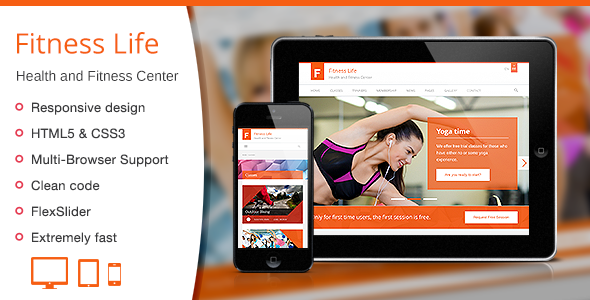
Fitness Life is a static HTML template built for gyms, fitness studios, spas and similar health and beauty businesses. Sold on ThemeForest by the developer WPlook for $20, it ships with pre-built pages for classes, trainers, memberships and news, and it is aimed at freelancers or small studios that want a ready-made front end rather than a content management system. The listing carries 313 sales and the item was last updated in January 2014.
That last detail matters more than any feature list, and it shapes everything below. Anyone searching for Fitness Life health-beauty options should understand up front that this is a front-end template, not a WordPress theme, and that its codebase has been frozen for over a decade.
What the Fitness Life health-beauty template actually includes
The core offer is a set of finished HTML pages covering the sections a fitness business typically needs. The vendor names classes, trainers, membership and a news list, plus a contact form. In practice that means a buyer gets a homepage, an about-style page, individual trainer profiles, a class or schedule listing, a membership or pricing page, a blog-style news index, and a contact page — all sharing one visual system so the site looks coherent without a designer assembling each screen from scratch.
The responsive layout is the other headline capability. The template adapts to tablet and phone screens rather than serving a fixed-width desktop grid, which was a meaningful selling point when it launched and remains the baseline expectation now. For a studio whose traffic skews mobile — people checking a class timetable on the way to work — that behaviour is the difference between a usable page and a pinch-to-zoom mess.
Because it is plain HTML, the template is framework-agnostic. It can be dropped into any hosting environment, paired with a static site generator, or used as the front end for a custom back end. There is no database requirement, no PHP dependency and no admin panel to secure. The vendor tags point at the intended subject matter — crossfit, pilates, kickboxing, spa, sport, training, membership — which tells you the page structure was designed around class-based businesses rather than, say, e-commerce catalogues.
What the listing does not state is equally worth noting. There is no mention of a page builder, a bundled icon set, a documentation file, a Figma or Sketch source, or any JavaScript component library. Buyers should assume they are getting markup, stylesheets and images, and should verify the contents before purchase if any of those extras are essential.
Where this template fits, and where it does not
The strongest fit is a small studio, personal training business or day spa that needs a brochure site quickly. A freelancer quoting a fixed-price job can use the existing pages as a starting skeleton, swap the placeholder imagery and copy, and deliver a presentable site in a short engagement. The same applies to a developer prototyping a fitness concept who wants realistic page structure without designing from zero.
It also suits anyone building a static or Jamstack site. Because there is no server-side logic, the markup can be templated into a generator and deployed to cheap static hosting with no database to maintain — an attractive option for a business that will never update content more than a few times a year.
The clearest case against buying is a business that expects to manage its own content. A gym owner who wants to add a new class, publish a blog post or change prices without calling a developer needs a CMS, and this template provides none. Choosing it means either accepting a developer in the loop for every edit or paying someone to wire the markup into a CMS later, which erases much of the cost saving.
The second case against is any project with modern expectations around accessibility, performance budgets or search visibility. A 2014 codebase predates a great deal of current best practice, and retrofitting it can cost more than starting fresh.
Setting it up: what the work actually involves
Installation itself is trivial. There is nothing to compile and no environment to configure — the files are uploaded to a host and served. The real work is customisation, and that is where the hours go.
Expect to replace the placeholder images, rewrite the copy, and adjust the colour palette and typography to match the client’s brand. That means editing CSS directly, since there is no visual theme editor. The vendor does not state whether a Sass or Less source is included, so a buyer should plan on working with the compiled stylesheet unless they confirm otherwise.
Wiring up the contact form is a separate task. A static HTML form needs a back-end endpoint or a third-party form service before it will send anything, and the template cannot supply that on its own.
For a competent front-end developer, a straightforward reskin is roughly a day’s work. A fuller build — custom pages beyond the supplied set, a CMS integration, or a redesign of the layout system — runs considerably longer and should be scoped as a project rather than a template tweak.
Strengths and limitations
Strengths
- Low entry cost at $20, with no ongoing licence fee.
- Purpose-built page set for class-based fitness and spa businesses, so the structure is already right.
- Responsive layout that handles tablet and mobile screens out of the box.
- No CMS, database or server dependency, which keeps hosting cheap and the attack surface small.
- 313 sales give it a longer track record than many niche templates, and the developer WPlook has a body of work on the marketplace.
Limitations
- Last updated in January 2014. The code has not tracked changes in browser behaviour, CSS practice or accessibility guidance for over a decade.
- No content management. Every text or image change requires editing files directly.
- No stated documentation, design source files or build tooling, so buyers cannot confirm what support material is included.
- Static forms need an external service to function.
- Styling changes mean hand-editing CSS, which is slow for anyone without front-end experience.
- The visual style reflects early-2010s web design conventions and will look dated without significant rework.
How it compares with the wider category
The realistic alternatives fall into three groups. The first is a modern HTML template from an actively maintained seller, typically priced between $15 and $30. These offer the same static-file simplicity but with current markup, better accessibility and often a build pipeline. The second is a WordPress theme in the same health-beauty category, usually $40 to $70, which trades the static simplicity for an admin panel the client can use. The third is a custom build, which costs far more but produces exactly the right site.
Fitness Life competes on price and on the narrowness of its page set. It is cheaper than most WordPress equivalents and its pages map cleanly onto a gym or spa business, which saves planning time. It loses on currency: a newer static template at a similar price will almost certainly be better built, and a WordPress theme solves the content-editing problem outright. The honest framing is that this template is a budget shortcut for developers, not a platform for business owners.
Frequently Asked Questions
Is Fitness Life a WordPress theme or an HTML template?
It is a plain HTML template, not a WordPress theme. The listing describes static pages rather than a theme package, and there is no mention of PHP templates, a functions file or any WordPress-specific structure. It cannot be installed through the WordPress admin; it would need to be converted into a theme or used as a standalone static site.
Can the site content be edited without touching code?
No. Because there is no content management system, every change to text, images or pricing means editing the HTML files directly and re-uploading them. A business that wants to update its own class schedule or publish news posts will need a CMS added on top, which is extra development work beyond the template price.
Is the template still maintained and updated?
The vendor’s last recorded update was January 2014, so it has not been maintained for over a decade. Browsers, CSS conventions and accessibility standards have all moved on since then. Buyers should treat it as a fixed codebase and budget for modernisation work rather than expecting future patches or support.
What do I need before I can launch a site with it?
Three things: web hosting, a domain name, and someone comfortable editing HTML and CSS. A contact form also needs a back-end endpoint or a third-party form service, since static markup cannot send email on its own. No database or server-side runtime is required, which keeps hosting simple and inexpensive.
Verdict
Fitness Life health-beauty is worth buying for a front-end developer or agency that needs a cheap, structurally sensible starting point for a gym, studio or spa site and is comfortable working directly in HTML and CSS. The page set is well matched to class-based businesses, the responsive behaviour is intact, and $20 is a low-risk outlay for a day’s saved layout work.
It is the wrong purchase for a business owner who wants to run the site themselves, for any project with a modern accessibility or performance requirement, and for anyone unwilling to modernise a 2014 codebase. Those buyers should look at a maintained HTML template or a WordPress theme instead, and accept the higher price as the cost of not doing remedial work later.