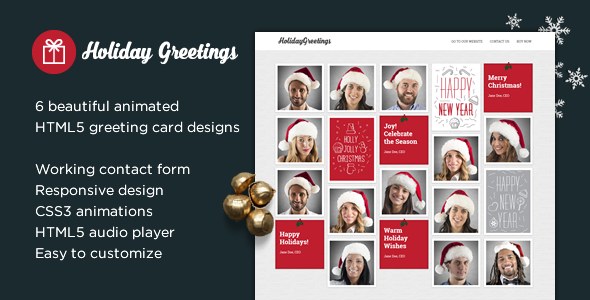
Holiday Greetings is a set of six HTML5 and CSS3 landing page templates that businesses can publish as a seasonal e-card instead of sending individual emails. Each demo pairs falling snow, animated lettering and optional background audio with a working contact form, and the package sells on ThemeForest for $10. It suits small teams, agencies and online shops that want a branded Christmas or New Year message on their own domain without commissioning a custom build.
What the Holiday Greetings Site Templates Actually Include
The package is built around six separate demo layouts rather than one design with colour variations. That matters because the demos differ in structure, not just palette: the vendor’s changelog notes that three additional demos were added in December 2015, and that one layout originally relied on a masonry plugin before being rewritten as a pure CSS3 grid. Anyone comparing the demos should expect genuinely different page compositions, which gives a team room to pick a layout that matches the tone of the message rather than forcing one template to fit every brand.
The animation layer is the product’s main selling point. Snow falls across the viewport using CSS3 rather than JavaScript, and the headline text animates in on load. Both effects are decorative, but they do the work that a static image cannot: they signal that the page is a greeting rather than a product page, which is the whole reason to publish a landing page instead of a banner ad. Because the snow is CSS-driven, it degrades more gracefully on older browsers than a canvas or script-based equivalent would.
Audio is handled through an HTML5 audio player. The vendor is explicit that the music heard in the live demo is not part of the download and must be purchased separately, so buyers should budget for a licensed track or supply their own file. This is worth flagging early, because a silent greeting card loses much of its intended effect and the extra cost is easy to overlook at a $10 price point.
Beyond the visuals, the templates ship with a functioning AJAX contact form that submits through PHP. That turns the page from a one-way broadcast into something a visitor can respond to, whether that response is a reply, an enquiry or an RSVP. Phone number validation was fixed in a December 2014 update, so the form has been through at least one round of real-world correction. Social media icons and Google web fonts round out the asset set, and the code is described as HTML5 valid and responsive across screen sizes.
Where These Seasonal Landing Pages Fit, and Where They Do Not
The clearest use case is a business that already has a mailing list and wants to stop sending individual festive emails. Publishing one page and pointing traffic at it saves the labour of personalising hundreds of messages, and it gives every visitor the same experience regardless of when they arrive. Online shops can push it further by using the page to promote a Black Friday or Cyber Monday offer, or by turning it into an advent calendar that reveals a different gift or discount each day. Agencies can rebrand a single demo and hand it to a client as a finished seasonal microsite.
It also works as a standalone seasonal site for a small organisation that has no year-round web presence at all. A restaurant, a dental practice or a local charity could register a domain, drop in a demo, and have a credible holiday page live the same afternoon.
Where it falls down is any project that needs to live inside an existing content management system. These are static HTML templates, not a WordPress theme or a plugin, so a site running WordPress, Shopify or Squarespace cannot simply install them. Integrating one would mean either hosting it as a separate subdomain or rebuilding the markup inside the existing platform’s template system, which erases most of the time saving. Buyers who need the greeting to appear at example.com/christmas on their current CMS should look at a seasonal theme or page builder add-on instead.
A second poor fit is any brand with strict accessibility requirements. Heavy animation and autoplaying audio are difficult to reconcile with WCAG conformance, and the vendor does not state that the templates include reduced-motion handling or audio controls beyond the player itself. Organisations in the public sector or regulated industries should treat that as a gap to close manually.
Setting Up a Holiday Greetings Template
Deployment is straightforward for anyone comfortable with a file manager or FTP client. The steps are: unzip the download, choose one of the six demos, upload the folder to a web host, and open the contact form’s PHP file to point it at a working email address. The form needs a server that runs PHP; static hosting services that only serve HTML will not process submissions without an alternative form handler.
Customisation is where the real time goes. Swapping the logo, headline text and colour values is a matter of editing the stylesheet and the markup, which a competent front-end developer can complete in an hour or two. Matching the animation timing to a specific brand feel, replacing the placeholder imagery and sourcing a licensed audio track will add more. A realistic estimate for a polished, on-brand result is half a day for someone who already knows HTML and CSS, and considerably longer for a non-technical owner working from the documentation alone.
The vendor describes the code as well organised and documented, and the changelog shows a maintenance pattern stretching from the original December 2013 release through to December 2018, covering jQuery updates, plugin refreshes and code revalidation. That history is a reasonable signal of care, though the most recent entry is now several years old.
Strengths and Limitations
Strengths
- Six structurally distinct demos rather than one layout recoloured, giving real choice without extra cost.
- CSS3 snow and text animation deliver the seasonal effect without heavy scripting.
- Working AJAX/PHP contact form turns a static greeting into a two-way touchpoint.
- Responsive HTML5 markup that the vendor states has been validated.
- Low price relative to commissioning a bespoke seasonal page.
- Documented update history across multiple years.
Limitations
- Background music is not included. The demo track must be licensed separately, which adds cost and a licensing step the $10 price does not cover.
- Static HTML only. There is no WordPress, Shopify or other CMS version, so the templates cannot be installed into an existing platform.
- The last vendor update was December 2018. jQuery and plugin versions from that era may need refreshing before deployment on a modern stack.
- No stated support for reduced-motion preferences or audio accessibility controls, which limits suitability for accessibility-sensitive projects.
- Customisation requires direct editing of HTML and CSS. There is no visual builder or admin panel.
How the Holiday Greetings Site Templates Compare With the Wider Category
The alternatives fall into three groups. The first is a seasonal WordPress theme or a page-builder template pack, which costs more but installs into an existing site and can be edited without touching code. The second is a general-purpose email or e-card service, which handles delivery and tracking but keeps the greeting on someone else’s domain and rarely allows deep branding. The third is a custom build, which offers complete control at many times the price.
Holiday Greetings sits between the first two. It gives more design control than an e-card service and costs far less than a custom build, but it asks for technical comfort that a theme or page builder does not. The trade-off is deliberate: buyers are paying for a self-hosted, fully brandable page and accepting that they will handle the hosting, the audio licensing and the code edits themselves. For a team with a developer available, that is a fair exchange. For a team without one, a CMS-based seasonal template is the more practical route.
Frequently Asked Questions
Do I need coding skills to use Holiday Greetings?
Yes, some. The templates are static HTML, CSS and a PHP contact form, so changing text, colours and images means editing files directly. There is no visual editor or admin dashboard. A developer can complete a rebrand in an hour or two, while a non-technical owner should expect to work slowly through the documentation or hire help.
Is the Christmas music in the demo included in the download?
No. The vendor states plainly that the music from the demo page is not part of the main download and links to a separate store where a track can be purchased. Buyers need to license their own audio or supply an existing file, otherwise the HTML5 audio player will sit empty on the finished page.
Can I use these Holiday Greetings Site Templates on WordPress?
Not directly. These are standalone HTML templates, not a WordPress theme, so they cannot be installed through the WordPress dashboard. The practical options are publishing the page on a separate subdomain or rebuilding the markup inside a WordPress template. Both work, but neither preserves the original time saving.
How many greeting card designs are included?
Six animated demos ship in the package. They differ in layout as well as styling, and three of them were added in a December 2015 update, with one later rewritten to use a pure CSS3 grid instead of a masonry plugin. Buyers can pick whichever composition suits their brand and message.
Verdict
Holiday Greetings is a sensible purchase for developers, freelancers and small agencies that want a self-hosted seasonal page and are comfortable editing HTML and CSS. At $10 for six demos, a working contact form and CSS-driven animation, the value is clear, and the 412 sales recorded on ThemeForest suggest a steady trickle of buyers have reached the same conclusion. It is a poor fit for anyone who needs the greeting to live inside WordPress or another CMS, and for organisations with accessibility obligations that autoplaying audio and heavy motion would breach. The missing music licence and the 2018 update date are the two details to weigh before buying, but neither is a dealbreaker for the right project. themeenergy has kept the package maintained across several years, which is more than many seasonal templates manage.