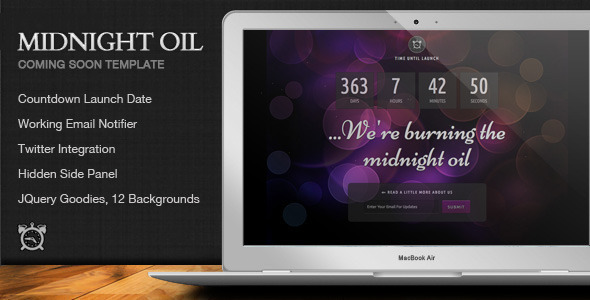
Midnight Oil is a static HTML and CSS template for building a “coming soon” or under-construction page before a website goes live. It bundles a countdown timer, an email signup notifier, a Twitter feed panel, animated text and twelve bokeh background patterns into a single downloadable package. It suits freelancers, small studios and site owners who need a placeholder page that looks deliberate rather than unfinished, and who are comfortable editing raw HTML.
The template is sold on ThemeForest under the Site Templates category by the developer SpiralPixelDesign, priced at $7, with 299 sales recorded at the time of writing. Among the wider family of Midnight Oil Site Templates, this is the entry-level option: a one-page holding screen rather than a multi-page site framework.
What the Midnight Oil template actually includes
The core function of any coming soon page is to buy time. Midnight Oil approaches that with a countdown timer driven by JavaScript, which counts down to a launch date set in a configuration file. Visitors see a live clock rather than a static “back soon” message, which sets an expectation and gives the page a reason to be revisited.
Alongside the timer sits a working email notifier. This is a signup form that collects addresses so the site owner can send a launch announcement. The vendor describes it as working, which matters because many cheap templates ship with a form that looks correct but posts nowhere. Buyers should still expect to connect it to their own mail service or script, since the template cannot know which provider is in use.
Several features exist mainly to make the page feel alive:
- Firefly sparks effect. A jQuery-driven particle animation that drifts across the background, adding motion without requiring video or heavy assets.
- CSS3 text animation. Headline and tagline text animates in on load, which draws the eye to the message rather than the background.
- Hidden side panel. A sliding panel that holds extra information — contact details, social links or a longer description — without cluttering the main screen.
- Twitter feed. Pulls recent tweets into the page so the holding screen shows activity even before the site launches.
- Twelve bokeh background patterns. Interchangeable blurred-light backgrounds, which is the fastest way to differentiate one deployment from another.
On the design side, the package includes PSD source files for the logo, email icon and social icons, so a buyer can adjust branding in Photoshop rather than reverse-engineering the CSS. Google Fonts are used for typography, which keeps the page lightweight and means no font files need to be hosted. The markup is described as valid HTML with documented CSS, and a documentation folder is included.
Browser support is listed as Internet Explorer 7 and above, plus Firefox, Safari, Opera and Chrome. That range reflects the template’s age rather than a current testing matrix, and it is worth reading as a historical claim.
Where a Midnight Oil coming soon page fits, and where it does not
The obvious fit is a project with a known launch date and no site yet. A restaurant opening in six weeks, a product page for a physical good, a SaaS waitlist, an event site, or a portfolio being rebuilt — all of these benefit from a single screen that captures emails and communicates a date.
It also works as a maintenance page. When a live site is taken down for a migration or a redesign, swapping in a Midnight Oil page keeps visitors informed and keeps the domain collecting signups instead of showing a server error.
Agencies may find it useful as a client-facing placeholder during the build phase, particularly because the twelve background patterns and the PSD icon files make it quick to apply a client’s colours and logo. At $7, deploying it across several client domains costs less than a single stock image licence.
It is the wrong choice in a few specific cases. Anyone who needs the holding page to match an existing WordPress theme’s design system should look at a coming soon plugin instead, because this is a standalone HTML template with no CMS integration — there is no admin screen, no shortcode and no settings panel. Anyone who wants a page that grows into a full website should also look elsewhere; Midnight Oil is a single screen, not a foundation to build on. And anyone who needs a form that stores submissions in a database will find the email notifier is a front end only, requiring an external service to actually receive anything.
Setting up the template in practice
Deployment is a file upload. The buyer unzips the package, opens the main HTML file, edits the countdown target date in the JavaScript file, points the signup form at a mail handler, and uploads the folder to a web host. No build tools, no package manager and no server-side language are required — a static host or any shared hosting account will serve it.
The prerequisites are modest but real. Editing the countdown date means opening a JavaScript file and changing a value, so some comfort with code is assumed. Connecting the email form requires an endpoint from a service such as a mailing list provider or a form-handling script; the vendor does not state which services are supported, so that step depends on what the buyer already uses. Changing the logo means either editing the PSD files in Photoshop or replacing the image assets directly.
Realistically, a first-time setup takes an hour or two, most of which goes on branding and the form connection rather than the upload itself. Reusing the template on a second project is much faster, since the structure is already understood.
One caveat about the Twitter feed: the vendor’s own update log records that the Twitter integration was removed in September 2013 because of an API change, then re-added in October 2013. Twitter’s API has changed substantially since then, so buyers should treat the feed as the least reliable component and verify it works before relying on it. The countdown timer and the email form are the parts that matter most, and both are self-contained.
Strengths and limitations
Strengths
- Very low price relative to what is included — twelve backgrounds, PSD icon sources and a documented codebase for $7.
- The countdown timer and email capture form are the two features that give a holding page a purpose, and both are present.
- PSD files for the logo and icons mean branding changes do not require rebuilding assets from scratch.
- Static HTML and CSS means it can be hosted anywhere, including free static hosting, with no database or server runtime.
- Twelve interchangeable backgrounds make it practical to deploy the same template across multiple projects without them looking identical.
- 299 sales indicate the template has been used and tested by a reasonable number of buyers.
Limitations
- The last vendor update was October 2013. More than a decade of browser and platform change has passed, so modern behaviour is not guaranteed and the vendor does not state current compatibility.
- The Twitter feed depends on an API that has been rewritten since the template was last touched, and the vendor’s own changelog shows it broke once already.
- There is no CMS integration. Editing copy means editing HTML files directly, which rules it out for non-technical site owners.
- The email notifier is a form front end only. It does not store addresses, so a third-party service or custom script is mandatory.
- It is a single page. There is no blog template, no inner pages and no design system to extend.
- Support depends on the developer responding through the marketplace. The listing offers help but makes no commitment about response times or how long support will continue.
How it compares with the alternatives
Coming soon pages are usually solved in one of three ways: a plugin inside an existing CMS, a hosted landing page service, or a standalone HTML template like this one.
Plugins win on convenience. They install in a minute, inherit the site’s existing theme and let a non-technical owner change text from an admin screen. They lose on portability — the page only exists inside that CMS, and it cannot be dropped onto a domain that has no installation yet.
Hosted services win on speed and on built-in email list management, since the signup data lands in their system automatically. They lose on control and on cost, because pricing is usually recurring and the design is constrained to what the service offers.
A standalone HTML template sits between the two. It is more work to set up than a plugin and less turnkey than a hosted service, but it can be uploaded to any host, needs no ongoing subscription, and gives complete control over the markup. Midnight Oil’s specific position within that group is the budget end: the feature set — countdown, email form, animated background, twelve patterns — is broader than most templates at this price, but the codebase has not been maintained since 2013. A buyer comparing options should weigh that trade-off directly: more included features, less current upkeep.
Frequently Asked Questions
Do I need to know how to code to use Midnight Oil?
Some basic HTML knowledge is required. Changing the launch date means editing a JavaScript value, and changing text means editing the HTML file. There is no admin panel or visual editor. A non-technical site owner would be better served by a coming soon plugin for WordPress or a hosted landing page builder.
Does the email signup form store addresses anywhere?
No. The template provides the form interface only, so submissions need to be sent to an external service or script. The vendor does not specify which providers are supported, so the buyer connects their own mailing list service or form handler. Without that step, the form will not deliver anything.
Is the countdown timer still working in modern browsers?
The countdown is plain JavaScript and is the most likely component to still function, but the vendor has not updated the template since October 2013 and makes no claim about current browser support. Testing on the target browsers before launch is the sensible approach, particularly if the page will be live for weeks.
Can Midnight Oil be used as a WordPress theme?
No. It is a standalone HTML template, not a theme, so it cannot be activated inside WordPress. It can be uploaded as a static file to a domain or subdomain, or placed in a directory alongside an existing installation. Integrating it into a CMS would require custom development work that the template does not provide.
Verdict
Midnight Oil is a sensible purchase for a developer, freelancer or small studio that needs a single holding page on a domain with no CMS, wants a countdown and email capture out of the box, and is comfortable editing HTML. The twelve background patterns and the PSD icon sources make it easy to adapt across several projects, and the $7 price makes the decision low-risk. It is not the right choice for anyone who needs to edit content without touching code, who wants the page to grow into a full website, or who needs a form that stores submissions natively. The 2013 last-update date is the main thing to weigh: the countdown and layout will likely still work, but the Twitter feed should be treated as unreliable and the template as a whole as unmaintained. Buy it as a cheap, self-contained placeholder, not as a long-term platform.