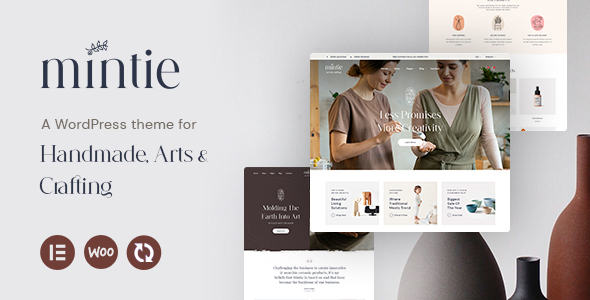
A WordPress theme built for handmade and craft retailers, Mintie pairs WooCommerce with the Elementor page builder and nine prebuilt storefront layouts. It supplies a working shop structure — product grids, cart and checkout, live search, quick product previews — so an arts and crafts seller can start from a designed base instead of a blank theme. The Mintie Ecommerce package suits independent makers, small studios and freelancers building a first craft shop on self-hosted WordPress; it is a weaker match for very large catalogues or multi-vendor marketplaces.
The theme is sold on ThemeForest for $59 by BoostifyThemes, has passed 200 sales and was last updated in February 2025. No rating figure accompanies the listing, so the demo files are the main quality signal available before purchase.
What the Mintie Ecommerce Theme Handles Well
The core of the product is a set of finished page designs that can be imported and then edited visually. Elementor handles that editing, which means layout changes such as moving a banner, resizing a product grid or reordering homepage blocks happen in a drag-and-drop interface rather than in template files. For a shop owner without a developer on retainer, that is the single most useful property of the theme.
Nine demo homepages ship with it. They are variations on the same craft-retail aesthetic rather than nine unrelated designs, which is a reasonable approach for a niche theme: the choice is about which merchandising angle to lead with — a hero image and a handful of featured pieces, a category-led grid, or a promotional strip built in Slider Revolution.
Two features address browsing friction directly. Real-time AJAX search returns product suggestions as a shopper types, and AJAX quick view opens a product preview in an overlay without a page reload. In a craft store, where a buyer may be comparing six glaze colours of the same mug, cutting those extra page loads matters more than it does in a store selling three SKUs.
The rest of the package is conventional but complete: mega menus for grouping categories such as ceramics, textiles and jewellery; a theme options panel for site-wide settings; Google Fonts; Contact Form 7 for commission enquiries and wholesale requests; responsive layouts; documentation; and dedicated support. The Mintie Ecommerce theme also bundles Slider Revolution, which at this price reduces the number of separate licences a new shop needs.
Which Projects Fit the Mintie Ecommerce Theme and Which Do Not
The strongest fit is a single-maker store moving off a marketplace platform onto its own domain, with a catalogue in the tens or low hundreds of products and a brand built on photography. The prebuilt aesthetic — warm, gallery-like, product-forward — means less design work before launch. Craft supply shops also fit well, since category-led mega menus handle the wide, shallow structure that supplies stores tend to have.
Agencies and freelancers get a second kind of value: a repeatable base for craft and artisan clients, where the demo importer removes the setup phase and the budget goes into branding instead. Artisan galleries with a small number of high-value pieces and enquiry-driven sales are another reasonable use, with Contact Form 7 carrying the enquiry flow.
Three situations call for a different choice. A shop planning hundreds of SKUs with complex attribute combinations — size, colour, material, finish — will need layered filtering that the listing does not describe. A multi-vendor marketplace needs commission splitting, vendor dashboards and payout logic that no single-vendor theme supplies. And a team committed to the block editor and full site editing will find Elementor’s canvas approach a step backwards rather than forwards.
What Setting Up Mintie Involves in Practice
The prerequisites are a self-hosted WordPress installation, WooCommerce, and a host that meets WooCommerce’s standard requirements. Elementor is needed for editing, Contact Form 7 for forms, and Slider Revolution comes bundled. None of this is unusual, but it does mean the site runs on a stack of four plugins before any extensions are added.
Importing a demo is the quick part: the one-click importer pulls in layouts, sample content and settings, and most owners will have a recognisable storefront within an afternoon once colours, fonts and logo are adjusted. The slower work is the part no theme removes — entering products with real photography and variations, configuring shipping zones and tax rules, connecting a payment gateway, writing returns and privacy pages, and testing checkout end to end. For a small catalogue, a few working days is a realistic estimate; a larger one takes considerably longer.
Strengths and Limitations of the Mintie Ecommerce Theme
Strengths
- A committed visual direction for handmade retail, which shortens the design phase compared with adapting a generic multipurpose theme.
- Elementor editing keeps structural changes out of code, so a shop can evolve without developer hours.
- Nine homepage variants allow different merchandising approaches to be tested against the same branding.
- Live search and quick view reduce the click cost of comparing similar handmade items.
- Slider Revolution is included, and the whole package costs $59 once rather than an annual subscription.
- The one-click importer removes the intimidating blank-canvas stage for first-time store owners.
- Documentation and dedicated support are listed, and the theme was updated in February 2025.
Limitations
- The two AJAX features cover search and preview only; layered product filtering and faceted browsing are not mentioned, so larger catalogues will need an extra plugin.
- No performance data is published, and an Elementor, WooCommerce and slider stack carries more assets than a hand-built theme. Anyone with strict Core Web Vitals targets should benchmark a staging copy first.
- The nine demos are homepage variants; the listing does not show nine complete store scenarios, so inner pages still need assembling.
- No rating or review data is supplied with the listing, leaving the demo as the only pre-purchase quality signal.
- Multilingual support, RTL layouts and multi-currency handling are not stated anywhere in the listing and should be confirmed directly with the developer.
- Around 200 sales is a modest install base, which usually means fewer community answers when something breaks.
How the Mintie Ecommerce Theme Compares With General WooCommerce Themes
The WooCommerce theme market splits three ways, and Mintie sits firmly in the niche-design camp. Multipurpose themes offer dozens of unrelated demos and broader plugin compatibility, but every craft shop built on one starts by fighting a layout designed for a software company.