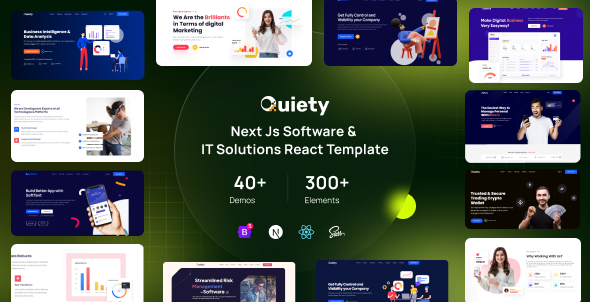
Quiety is a static site template built on Next.js and React, aimed at software companies, SaaS products, IT service providers and digital agencies that need a marketing site without starting from a blank repository. It ships with more than 36 homepage demos and roughly 20 inner pages, styled with Bootstrap 5 and priced at $24 on ThemeForest. Buyers get a front-end codebase rather than a finished website: content, hosting and any dynamic functionality are still the purchaser’s responsibility.
The listing carries 358 sales and has been maintained since 2022, with the most recent release in July 2025 moving the project to Next.js 15.3.4. That update history matters more than the headline page count, because a React template that lags behind its framework version becomes a liability the moment a buyer runs an install command.
What the Quiety Site Templates package actually contains
The core of the offer is breadth of layout. Thirty-six homepage variations cover territory that includes SaaS products, AI tools, CRM and help desk software, payment gateways, marketplaces, cybersecurity, crypto, insurance, event and conference sites, and several flavours of agency. Rather than buying a single-purpose landing page and rebuilding it, a buyer can pick the demo closest to their sector and adapt it.
Inner pages follow a conventional marketing site structure: about, services with detail views, support and support detail, careers with job detail, integrations, pricing, blog and blog post, plus authentication screens for login, signup and password reset. There is also a coming soon page and a 404. Reusable sections are included, which is the practical detail here — a hero block or pricing table can be lifted from one demo into another instead of being rebuilt.
Technically, the template runs on Next.js with React, uses Bootstrap 5 for layout and components, and carries no jQuery dependency. Dropping jQuery is not cosmetic: it removes a legacy script from the bundle and keeps the codebase consistent with how modern React projects are written. Fonts come from Google Fonts (Poppins and Open Sans), icons from Font Awesome, and the vendor states the markup is W3C validated. Dark mode support was added in the July 2025 release.
Two practical points sit alongside the feature list. The first is that this is a static template — there is no CMS, no database and no server-side business logic. The second is that demo images are licensed from Unsplash, Pexels, Pixabay and Isometric and are not included in the download; they exist for preview only. Any buyer planning to launch needs their own imagery, which is a real cost in both time and licensing.
Which projects suit Quiety and which do not
The strongest fit is a software or IT company that needs a credible marketing presence quickly. A SaaS startup preparing for a launch, an agency repositioning its own site, or a freelancer delivering a client project on a fixed timeline all benefit from starting with a demo that already matches the sector. The multiple agency demos — digital, creative, design, marketing — mean an agency site can be stood up without inventing a layout from scratch.
It also suits teams already comfortable in React. If the developer maintaining the site knows Next.js, the template is a head start. If nobody on the team writes JavaScript, the opposite is true: editing JSX components is a different skill from editing a WordPress theme, and the apparent simplicity of the demo pages hides that.
Where Quiety is the wrong choice is any project that needs a content management system out of the box. A blog that non-technical staff must update daily, a product catalogue, a customer portal, or anything requiring user accounts and stored data will need a backend and a CMS bolted on. At that point the buyer is paying for a design system and then building the application around it. Similarly, anyone who wants a WordPress theme should stop here — this is not one, and the vendor says so explicitly.
Setting up the template in practice
Installation assumes a working Node.js environment and familiarity with the command line. The typical path is to download the package, install dependencies with npm or yarn, and run the development server locally. From there, the buyer picks a demo, removes the pages and components they do not need, and replaces placeholder text and imagery with real content.
Because the template uses the Next.js App Router conventions of its era, the file structure will be familiar to anyone who has worked in Next.js 13 or later. The vendor provides documentation, and the changelog shows dependencies are periodically brought up to stable versions — worth checking before purchase, since a template pinned to an old React version can create upgrade work later.
Realistically, a developer can have a demo running locally within an hour and a first customised page within a day. A full production site — real copy, licensed images, SEO metadata, analytics, form handling and deployment — is a project measured in days or weeks depending on how much of the demo survives. The template accelerates the design and scaffolding stages; it does not remove the content and integration work.
Strengths and limitations of Quiety Site Templates
Strengths
- Unusually wide demo coverage for the price, spanning SaaS, AI, CRM, fintech, security and multiple agency niches.
- Built on Next.js 15.3.4 and React with Bootstrap 5, and free of jQuery, so the stack matches current practice.
- Authentication screens and a full set of marketing inner pages reduce the number of components that must be written from zero.
- Reusable sections make it practical to mix layouts across demos rather than committing to one.
- Dark mode support and a documented changelog going back to 2022 indicate ongoing maintenance.
- At $24, the cost is negligible against the hours saved on layout and responsive styling.
Limitations
- Static only. There is no CMS, database or backend, so any dynamic feature is additional development.
- Demo images are not included in the download. Every photograph must be sourced and licensed separately.
- No refunds for mistaken purchases or changes of mind, which raises the cost of buying the wrong stack.
- Thirty-six homepages is more than most buyers need, and the volume makes choosing and pruning slower than a focused template would be.
- Customisation requires React and JSX knowledge; the vendor does not state any no-code editing option.
- Bootstrap 5 styling means the visual language follows Bootstrap conventions, which can feel generic without deliberate design work.
How Quiety compares with other site templates in this category
The realistic alternatives fall into three groups. The first is a conventional HTML template, which is cheaper to host and simpler to edit but lacks component structure and routing. The second is a WordPress theme, which brings a CMS and a plugin ecosystem but a different development model entirely. The third is a bespoke build, which offers total control at a much higher cost in time.
Quiety sits between the first two and the third. It offers more engineering structure than an HTML template and more design variety than most single-purpose React starters, without the CMS that WordPress provides. Against other Next.js templates, its differentiator is demo count and sector coverage rather than any unique technical feature — the underlying stack is standard. For a buyer who values picking a near-finished layout over assembling one, that breadth is the whole argument.
Frequently Asked Questions
Is Quiety a WordPress theme or an HTML template?
Neither. Quiety is a static Next.js template built with React and Bootstrap 5, and the vendor states this plainly in the listing. It cannot be installed into WordPress, and it does not run as a plain HTML site without a build step. Buyers who need a WordPress theme should look elsewhere.
Do the demo images come with the template?
No. The images used in the live previews are sourced from Unsplash, Pexels, Pixabay and Isometric and are excluded from the downloadable file. They appear for demonstration only. Anyone launching a site built on Quiety must supply their own photography or licensed stock, which is an additional cost to budget for.
What technical skills are needed to customise Quiety?
Comfort with React and Next.js is effectively required. Customisation means editing JSX components, adjusting Bootstrap classes and running a Node.js build. A developer familiar with the stack can adapt a demo quickly; someone without JavaScript experience will find the learning curve steep, and the vendor does not advertise a visual, no-code editor.
Does Quiety include a CMS or admin panel?
No. It is a static front-end template with no CMS, database or admin interface. Blog posts, pricing tables and service pages are hard-coded components. Adding editable content requires integrating a headless CMS or another backend, which is separate work outside the scope of the $24 purchase.
Verdict on Quiety Site Templates
Quiety is a sensible purchase for a developer or agency that already works in React and Next.js and needs a marketing site for a software, SaaS or IT business without designing every page from scratch. The demo range is the main draw, and the July 2025 update to Next.js 15.3.4 shows the author, ThemeTags, is still maintaining the product rather than abandoning it after launch.
It is the wrong purchase for anyone expecting a CMS, a WordPress theme, or a no-code editing experience, and the no-refund policy makes that distinction worth taking seriously before checkout. Buyers should also budget for stock imagery, since none is included.
For the intended audience — technically capable teams with a static marketing site to build — the price is low relative to the layout work it removes, and the breadth of demos means most software and IT niches are already covered.