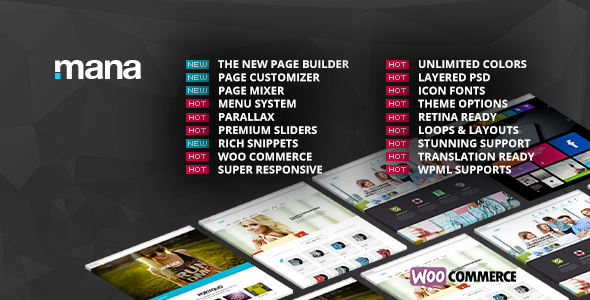
Mana is a multipurpose WordPress theme sold on ThemeForest for $49, built by the developer themeton on the Bootstrap 3 framework. It targets small businesses, agencies and freelancers who want one licence to cover several kinds of site — corporate pages, portfolios, blogs and a small shop — without hiring a developer for every layout change. The listing has accumulated 1,123 sales, which puts it in the established rather than experimental bracket for a business theme.
What Mana business sites can actually build with the bundled tools
The core of the theme is a drag-and-drop page builder, and the vendor counts 33 elements inside it. The ones that matter most for a Mana business site are the row element, which supports up to six columns with custom background and full-width options, and the service element, which ships with 14 preset styles. Those two cover most of what a services page needs: a grid of offerings with icons, headings and short descriptions, arranged without touching code.
Blog and portfolio presentation is unusually deep for a theme at this price. There are 11 blog layouts — regular, centred, image left, image right, metro, three grid widths and three masonry widths — plus a separate metro blog style with 16 post variations. The portfolio element offers 7 layouts. A studio that publishes case studies and long-form articles can give each section its own visual rhythm instead of forcing everything into one template.
Header and menu control is the other standout. Five header arrangements are included, from a centred logo with a wide menu beneath it to a left logo paired with an icon or metro menu on the right. Six menu styles sit underneath that, including a transparent variant and a mega menu with custom colours, icons and column counts. A top bar can hold custom text, a menu, a shopping cart, a language switcher or social icons, positioned left or right.
Sliders are handled by bundled premium plugins: LayerSlider and Revolution Slider are both included, which the vendor values at $30 in savings. There is also a dedicated image slider element that places screenshots inside iPhone, iPad, MacBook and iMac frames — useful for app or software marketing pages where a plain screenshot looks flat.
Elsewhere the theme is Retina ready, offers wide, boxed and attached page layouts, includes a one-page template, and provides a page customiser that lets each page override the top bar, header, page title, content background, footer and sub-footer independently. WooCommerce support, WPML compatibility with a certificate from WPML.org, PO/MO translation files, unlimited sidebars, six extra widgets and post formats for video, audio, gallery, chat, image and quote round out the feature set. Detailed PSD files ship with the download.
Where Mana fits well, and where it does not
The best fit is a small agency or freelance studio that maintains several client sites and wants a single theme it already knows. The layout variety means a restaurant site, a consultancy site and a photographer’s portfolio can all run on the same codebase, which cuts the learning curve on each new project to almost nothing.
It also suits a business that publishes heavily. The combination of 11 blog layouts, metro post styles, post format support and category, archive, author, tag and search templates means editorial content does not look like an afterthought bolted onto a marketing page.
A third good fit is a company adding a small store to an existing brochure site. WooCommerce is supported and the cart can live in the top bar, so the shop feels integrated rather than appended.
Where Mana is the wrong choice: projects that need block-based editing. The theme predates the WordPress block editor’s maturity and relies on its own builder, so a team standardised on native blocks, theme.json and full site editing will find the workflow foreign. Anyone building a site that must run on current WordPress with no legacy plugin dependencies should also look elsewhere, because the last vendor update was September 2020.
Setting up Mana in practice
Installation follows the standard route: upload the theme zip through the WordPress admin, activate it, then install the required and recommended plugins. LayerSlider, Revolution Slider and the bundled page builder are separate installs, and skipping them leaves parts of the demo content broken.
From there, the realistic path is to import the demo content, then strip it back. That gives a working reference for how the builder elements, headers and menus are configured, which is faster than building from an empty canvas. Expect the import and cleanup to take an hour or two.
Prerequisites are modest: a WordPress install, PHP 7.2 or later, and enough hosting to run two slider plugins. The theme options panel alone exposes more than 135 settings, and the page customiser adds per-page overrides on top, so the configuration phase is where most of the time goes. A straightforward five-page business site with a contact form and a blog is a one-day job for someone comfortable with WordPress. A WooCommerce build with custom product templates will take longer.
Documentation is not described in the listing, and the vendor points to ThemeForest discussion threads, email and a forum for support rather than naming a documentation portal. Buyers should factor that in.
Strengths and limitations
Strengths
- Genuine layout depth: 11 blog layouts, 7 portfolio layouts, 5 headers and 6 menu styles from one licence.
- Two premium slider plugins bundled, which offsets part of the $49 price.
- WPML compatibility certificate, with PO/MO files included for translation work.
- Per-page customiser overrides mean individual pages can break from the global template without custom CSS.
- Retina-ready output and PSD source files for designers who need to match assets to the theme.
- Established sales history of 1,123 purchases, so the theme is not an untested experiment.
Limitations
- The last recorded update is 3 September 2020. That is a long gap for a theme that bundles two slider plugins, and buyers should check current WordPress and PHP compatibility before committing.
- The theme is built on Bootstrap 3, a framework generation that has since been superseded. Sites built on it inherit that older grid and its conventions.
- It depends on its own page builder rather than native WordPress blocks, which locks content into the theme’s editor.
- Two slider plugins plus a builder is a heavy plugin stack for a small business site, with more update surface to manage.
- No documentation portal is named in the listing; support runs through ThemeForest threads, email and a forum.
How Mana compares with the wider business theme category
Multipurpose business themes compete on roughly three axes: how many layouts they ship, how much they depend on bundled plugins, and how actively they are maintained. Mana is strong on the first. The header, menu, blog and portfolio counts are above what most single-purpose themes offer, and the page customiser is a genuine convenience rather than a checkbox feature.
On the second axis it sits in the middle. Bundling LayerSlider and Revolution Slider adds value at purchase but also adds two third-party codebases to keep patched. Themes that rely on core WordPress features instead carry less long-term maintenance weight.
Maintenance is where Mana is weakest against the category. A theme updated in 2020 competes against options with recent release notes. For a new project that needs to last several years, that gap matters more than any individual feature. For a site already running an older stack, or a rebuild where the design is settled and the timeline is short, the feature depth can still justify the price.
Frequently Asked Questions
Is Mana compatible with the current version of WordPress?
The vendor does not state compatibility with recent WordPress releases. The last update was September 2020, which fixed PHP 7.2 issues and a WPML mega menu conflict. Buyers should test on a staging install with their target WordPress and PHP versions before using it on a live site.
Does Mana work with WooCommerce?
Yes. WooCommerce support is listed, and the theme’s release notes include fixes for WooCommerce 3 compatibility and an obsolete function. The shopping cart can be placed in the top bar or sub-footer. Newer WooCommerce versions are not addressed in the changelog, so verification on a test install is advisable.
Can Mana be translated into other languages?
Yes. Mana is translation ready with PO and MO files included, and it holds a WPML compatibility certificate, which the vendor links to on WPML.org. That makes it viable for multilingual business sites. The changelog also records a fix for a WPML conflict in the mega menu.
What do I need to install alongside the Mana theme?
LayerSlider, Revolution Slider and the theme’s own drag-and-drop page builder are separate plugin installs. The theme also ships with six additional widgets and supports unlimited sidebars. Skipping the bundled plugins leaves parts of the demo content and slider elements non-functional, so all three should be installed during setup.
Verdict
Mana is worth buying for freelancers and small agencies that want one theme covering many project types and are comfortable working inside a bespoke page builder. The layout variety, bundled sliders and per-page customiser deliver real value at $49, and 1,123 sales suggest the theme has been used in production. It is not the right pick for teams standardised on native WordPress blocks, nor for anyone starting a long-lived project that needs a vendor actively shipping updates. The 2020 last-update date is the deciding factor: if that risk is acceptable, the feature set holds up; if not, a more recently maintained theme is the safer call.