Boutique Grid is a magazine-style WordPress theme sold on ThemeForest for $49, built around masonry grids, a bundled ratings plugin and infinite-scroll archives. The listing carries the full title Boutique Grid = Creative Magazine WordPress Theme, and that name describes the intent accurately: an image-led editorial layout for blogs and publications rather than a general-purpose business template. It is worth considering for publishers, fashion and lifestyle blogs, and freelancers building content-heavy sites who want a distinctive grid front page without commissioning custom development.
What Boutique Grid = Creative Magazine WordPress Theme Does Best
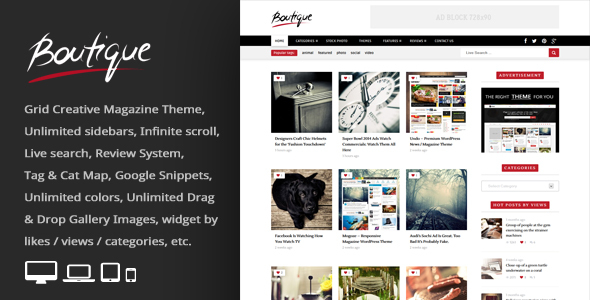
The theme’s centre of gravity is the grid. Article cards are arranged in a masonry layout, meaning items of different heights stack into columns and fill the gaps underneath one another instead of aligning to a rigid row. Combined with the drag-and-drop gallery builder, which lets an editor assemble a per-post image set rather than relying on a single featured image, the front page reads more like a magazine cover than a chronological blog feed.
Discovery tools are unusually well developed for a theme at this price. Live search returns results with post thumbnails while the visitor types, so a reader scanning for a specific shoot or interview sees images rather than a plain list of headlines. A tag and category index map gives a second route into the archive for readers who prefer browsing by section. Both matter on sites where the archive grows past a few hundred posts and the standard category dropdown stops being useful.
Engagement is handled through likes and view counters rather than comments alone. Two of the six bundled widgets surface hot posts by likes and hot posts by views, and the remaining four cover an accordion block, most-used tags with a configurable count, posts by category, and a video widget that mixes a YouTube or Vimeo clip with text. Editors can therefore build a sidebar of popular content without installing a separate plugin or writing queries.
Reviews are supported by the Taqyeem Ratings and Reviews plugin, which the vendor bundles and values at $14. That gives a site star ratings and score boxes for products, films or restaurants without a second purchase, though it does create a dependency on a plugin maintained outside the theme’s own release cycle.
Layout control sits in a custom options panel rather than the standard WordPress Customizer. It exposes colour controls, logo and favicon fields, an analytics field for a tracking ID, and unlimited menu depth. Sidebars are similarly flexible: an unlimited number can be created and assigned to individual pages and posts, so a sponsored article can carry a different sidebar from the rest of the site. The vendor also states structured data output for Google snippets, localisation files for translation, and XML sample content for a demo import.
Where Boutique Grid Fits, and Where It Does Not
This theme suits editorial projects with a strong visual rhythm. Fashion and streetwear blogs, lifestyle magazines, photography portfolios and food or travel publications are the obvious matches, because the grid rewards sites that publish strong images at a steady cadence. Review-driven operations also benefit: a gadget blog or film site can score entries with the bundled plugin and let the hot-posts widgets do the curation. Agencies building a content hub for a client on a fixed budget will find the unlimited sidebars useful for ad placements.
It is the wrong choice for a WooCommerce store. The feature list makes no mention of shop templates, cart styling or product grid integration, so a retailer would be buying a magazine theme and then rebuilding commerce layouts from scratch. The same applies to corporate brochure sites where the priority is a services page and a contact form rather than an archive. Teams that have standardised on the block editor and full site editing should also look elsewhere, because the theme’s structure is driven by its own options panel and widgets rather than block templates.
What Setup Actually Involves
The prerequisites are modest: a self-hosted WordPress installation on version 6.7 or later, as the vendor states, file access for installing the theme package, and a hosting account that can handle image-heavy pages. Buyers download the theme archive from ThemeForest, upload it through the WordPress admin, and activate the licence.
From there the sequence is familiar. Install and activate the bundled Taqyeem plugin if reviews are needed, import the XML sample data to get the demo layout, then work through the options panel to set colours, logo, favicon and the analytics ID. Menus and widget areas come next, followed by the sidebar assignments, which take longer than expected on a large site because each page and post can hold its own. Building real content on top of the demo import is the biggest variable. A demo-like setup can be done in an hour or two; a genuine launch with custom imagery, rewritten categories and sidebar strategy is closer to a day.
Strengths and Limitations
Strengths
- A genuinely distinctive masonry front page that does not look like a default blog template.
- Live search with thumbnails and a tag and category index, both of which improve archive browsing on large sites.
- Six purpose-built widgets covering popular posts by likes and views, tags, categories, accordion and video.
- Unlimited sidebars assignable per page and post, which is rare at this price point.
- The Taqyeem review plugin is included rather than sold separately.
- 244 sales on ThemeForest and a version 4.1 release in December 2024 indicate a theme still being maintained by An-Themes.
Limitations
- The feature list still advertises Internet Explorer 8 to 11 compatibility, which points to a codebase with older roots and legacy CSS. Buyers should test the demo against current browser behaviour rather than assume the layout is fully modern.
- No page builder integration is stated. Anyone expecting to reshape templates with Elementor or WPBakery will be limited to what the options panel exposes.
- Infinite scroll loads more posts automatically, but it breaks the numbered pagination structure crawlers and ad networks rely on. The vendor does not document an SEO fallback for the archive.
- There is no WooCommerce support in the listing, so e-commerce is out of scope.
- Reviews depend on the bundled Taqyeem plugin, which is a separate product with its own update schedule.
How It Compares With the Wider Category
Magazine themes broadly split into three groups: multipurpose themes with a magazine demo, block-based themes built for full site editing, and dedicated editorial themes like this one. Multipurpose themes offer more templates and plugin compatibility but rarely produce a grid this specific without configuration work. Block themes give more future-proof editing and cleaner markup, though the masonry and live-search behaviour here is not something a block theme delivers out of the box. Dedicated editorial themes compete on layout character and built-in discovery tools, which is exactly where Boutique Grid is strongest.
The trade-off is flexibility. A multipurpose theme bends to whatever project arrives next; this one is optimised for publishing and does that job with fewer moving parts. Buyers weighing it against alternatives should decide whether they need a specialised editorial layout or a general foundation they can adapt repeatedly.
Frequently Asked Questions
Does Boutique Grid work with the latest version of WordPress?
Yes. The vendor lists WordPress 6.7 and above as supported, and version 4.1 shipped in December 2024, which is recent enough to suggest active compatibility checks. The theme has not been submitted for testing against releases after that point, so anyone running a much newer WordPress version should confirm behaviour on a staging copy before switching a live site.
Do I need to buy a separate plugin to show ratings and reviews?
No. The Taqyeem Ratings and Reviews plugin is bundled with the theme at no extra cost, and the vendor values it at $14 on its own. It adds score boxes and star ratings to posts. Because it is a separate product, it has its own update cycle, so buyers should expect to manage two update streams rather than one.
Can Boutique Grid be used for an online store?
Not practically. The listing makes no mention of WooCommerce templates, product grids or cart styling, so a shop would need significant custom work on top of the theme. It is designed for editorial content: articles, categories, galleries and reviews. Retailers are better served by a theme built for commerce that also offers blog layouts.
Is infinite scroll bad for SEO?
It can be, if it replaces pagination entirely. Infinite scroll loads additional posts through scripts, which search engines may not follow the way they follow standard paginated links. The vendor does not document an SEO fallback for the archive pages, so sites that depend on organic traffic should confirm pagination exists or limit infinite scroll to specific templates.
Verdict
Boutique Grid is a sensible purchase for publishers, bloggers and small agencies that want a magazine layout with real character and a working set of editorial tools for $49. The masonry grid, live search and sidebar flexibility deliver more than most themes at this price. It is not the right buy for online stores, corporate sites, or teams committed to block-based site editing. Anyone who