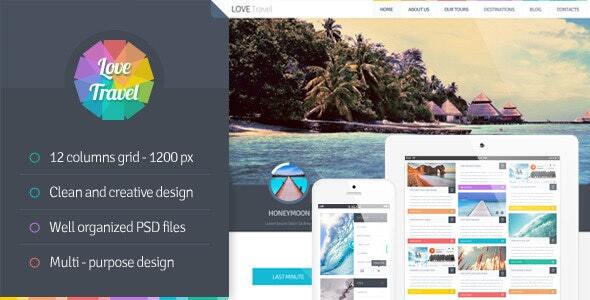
Love Travel is a multi-page Photoshop template for travel agency, tour operator and tourism websites, sold on ThemeForest by the developer nicdark for $10. Buyers receive layered PSD files for every page in the design, a 1200px twelve-column grid, and a set of PNG icons, which they can edit and then hand to a developer for conversion into a working site. It suits freelancers and small studios that want a ready-made travel layout rather than a coded theme, and it is not a WordPress product.
What the Love Travel Photoshop template actually gives you
The package is a design kit, not a website. Everything inside it is a static Photoshop document (PSD), the layered file format designers use to build page mockups. That distinction matters more than any single feature, because it determines who can use the product and what still has to happen before a site goes live.
A complete set of page layouts rather than a single homepage
The listing describes the item as a multi-page theme, and the PSD files mirror that: buyers get designs for more than one screen, so a project can be planned end to end instead of stopping at a landing page. For a tour operator that needs a homepage, destination listings, a package detail view and a contact screen, having all four drawn in one visual language saves the tedious work of inventing a consistent layout from scratch. The practical benefit is speed at the concept stage — a full site can be shown to a client in an afternoon.
A strict grid that survives handoff
The design uses a 1200px grid with twelve columns, a content width of 1180px and a full-width canvas of 1200px. Those numbers are unglamorous but useful. A developer receiving the file knows exactly where columns fall, so spacing decisions do not have to be renegotiated during build. Bootstrap and most CSS grid frameworks use a twelve-column system by default, which means the layout maps cleanly onto common front-end tooling. The 1180px content area also leaves a small gutter on either side, a detail that keeps content from touching the screen edge on mid-sized monitors.
Organised layers and an editable source file
Layers are the stacked elements inside a PSD — text, shapes, images and effects. The vendor states the layers are well organised, which in practice means groups are named and elements can be hidden or moved without hunting through a flat pile of shapes. This is where a cheap template usually fails, and it is the first thing worth checking after purchase. A tidy layer stack lets a designer swap photography, rewrite headlines and recolour accents without rebuilding the page.
Icons and a defined typeface
Glyphicons PNG icons ship with the package and can be used freely, which removes one small licensing question and one small design task. The typography is set in Signika, a humanist sans-serif with open letterforms that reads clearly at small sizes. Anyone customising the design should note that Signika is a separate font with its own licence; the vendor does not state whether a webfont licence is bundled, so that is worth confirming before launch.
A flat visual style built for travel imagery
The design is described as flat, clean and modern, with tag words spanning beach, cruise, honeymoon, summer, sea and tour. Flat design — illustration and colour blocks without depth effects or gradients — puts the emphasis on photography. For a tourism brand that is the right call, because the destination shots do the selling and heavy interface styling would compete with them.
Where the Love Travel PSD fits, and where it does not
The obvious fit is a small travel business that needs a designed site but has no in-house designer: a boutique tour operator, a honeymoon planner, a cruise agent, a guesthouse or a resort. It also works for a travel blogger who wants a clean editorial shell, and for a web agency that needs a credible travel mockup for a pitch without spending design hours on it.
A second, less obvious fit is the creative agency itself. The vendor mentions this, and the reasoning holds: the layout is generic enough in structure that a studio could adapt it for a service business with a photographic identity. At $10, using it as a starting skeleton is cheaper than starting from an empty canvas.
The wrong choice is a buyer who wants a working website. Love Travel is a Photoshop file. There is no HTML, no CSS, no WordPress theme, no page builder compatibility and no admin panel. Anyone without Photoshop or a designer on hand will get nothing usable from the download. Equally, a business that needs booking flows, availability calendars, search filters or payment integration should look at a coded theme or a dedicated booking platform — none of that logic can live inside a PSD, and the design does not claim to include it.
What setup and customisation involve
Buying and downloading takes minutes. Opening the files requires Adobe Photoshop, ideally a recent Creative Cloud version; older copies may open the documents but can misrender smart objects and layer effects. The vendor does not state which Photoshop version was used to build the files, so it is worth checking compatibility notes before purchase if the software on hand is old.
From there the work is design work. A realistic path for a simple project runs through four steps: replace the placeholder photography with licensed images, edit copy and typography, adjust colours to the brand, then export. Placeholder images in the preview are sourced from a wallpaper site and are not licensed for commercial use, so new photography has to be bought or shot.
Converting the finished design into a live site is the larger task. A developer slices the PSD or rebuilds it in HTML and CSS, then typically ports it into WordPress or another CMS. For an experienced front-end developer, a multi-page static design of this complexity is a few days of work. For a small business hiring that out, it is a project cost far larger than the template price, and that should be budgeted from the start. Total time from download to launch, for a team that already has images and copy ready, is realistically one to three weeks.
Strengths and limitations of this travel PSD template
Strengths
- Very low entry cost at $10, which makes it viable as a moodboard, a pitch asset or a throwaway starting point.
- Multiple page designs in one consistent style, so a whole site can be presented rather than a single screen.
- The 1200px twelve-column grid with a 1180px content width translates cleanly to common front-end frameworks.
- Organised layers reduce the time spent reverse-engineering someone else’s file.
- Neutral, photography-led flat styling that does not fight the destination imagery.
- Free Glyphicons PNG set included, cutting one licensing step.
Limitations
- No code of any kind. The product is static design only, so a developer or a conversion service is mandatory.
- Only one layout family in one visual style. A project needing a distinctly premium or editorial travel aesthetic will have to depart from the template substantially.
- Preview photography is drawn from a free wallpaper source and is not cleared for commercial use, so the entire image set must be replaced.
- The vendor does not state whether a webfont licence for Signika is included, leaving a licensing gap to resolve independently.
- No documentation is described, and the PSD format itself assumes working knowledge of Photoshop groups, smart objects and layer styles.
- Last updated in September 2024, so support for newer Photoshop features and any ongoing maintenance should be verified rather than assumed.
How it compares with other travel templates
The travel template market splits into three tiers, and placement matters more than brand names. At the bottom are raw PSD kits like this one: cheap, design-first, and requiring a build step. In the middle sit HTML templates, which ship with coded pages a developer can deploy quickly and are usually priced in the tens of dollars. At the top are full CMS themes, typically $40 to $70, which include a WordPress or similar install, a page builder, demo content and updates.
Against the PSD tier, Love Travel competes on price and on layer hygiene rather than originality — the flat travel look is a well-worn style, and buyers are really paying for a head start. Against HTML templates it loses on convenience, since a coded template removes an entire development phase, but it wins on flexibility, because a PSD can become any framework the team prefers. Against CMS themes it is not a direct competitor at all; the two solve different problems. The honest framing is that this is the cheapest possible route to a designed travel layout, provided the buyer already has, or can hire, the skills to finish the job.
Frequently Asked Questions
Is Love Travel a WordPress theme?
No. Love Travel is a Photoshop PSD template, not a WordPress theme or plugin. The download contains layered design files for the pages, which must be converted into HTML and CSS and then integrated into WordPress or another CMS by a developer. Buyers wanting an installable theme should look elsewhere, because nothing here can be uploaded to a site.
Do I need Photoshop to use the Love Travel Photoshop files?
Yes. The files are in PSD format and require Adobe Photoshop, ideally a current Creative Cloud subscription, to open and edit. Free alternatives such as GIMP or Photopea can open PSDs, but complex layer styles and smart objects may not render identically, so results can vary. The vendor does not state which Photoshop version was used.
Can the images in the preview be used on a live site?
No. The photography shown in the preview comes from a free wallpaper source and is not licensed for commercial use. Every image must be replaced with properly licensed stock photography or original shots before the design is published. The included Glyphicons PNG icons, by contrast, are described as free to use.
How much does it cost to turn this PSD into a working website?
That depends entirely on who does the work. The template itself costs $10, but conversion to a coded, CMS-driven site is a separate development project that typically runs into hundreds or thousands of dollars, or several days of a developer’s time. The vendor does not offer a conversion service or quote one.
Verdict
Love Travel is a sensible purchase for a designer, agency or technically confident freelancer who needs a travel site design quickly and is comfortable working in Photoshop. The 245 sales recorded on ThemeForest suggest the item has found a modest audience, and the low price makes the risk trivial. It is equally a reasonable buy for a small tour operator who already works with a developer, since the design removes the most expensive early stage of the project.
It is the wrong purchase for anyone expecting a website, a WordPress theme or a no-code solution, and for businesses whose brand needs a distinctive visual identity rather than a clean starting point. The absence of code, documentation and licensed imagery means the true cost sits well above the $10 price tag. Buy it for the layout, budget separately for the build.