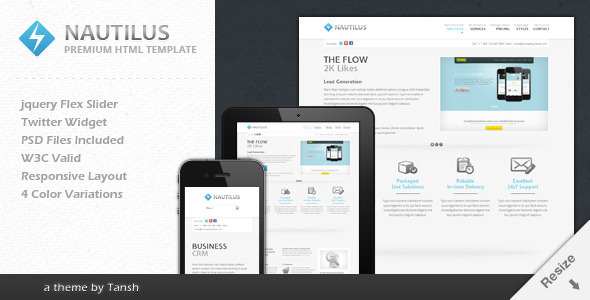
A static HTML and CSS template for corporate and service businesses, the Nautilus One Page Responsive Business Template sells on ThemeForest for $14 and delivers a single scrolling layout with a Flex slider, a contact form, a Twitter feed block and the original layered PSD files. It suits freelancers and small agencies who are comfortable working in raw markup; it is not a WordPress theme and will frustrate anyone expecting to edit content through an admin panel.
What the Nautilus One Page Responsive Business Template Actually Provides
The product is built around a single-page structure. Instead of several linked pages, the layout stacks sections — typically a hero area, a services block, an about panel, a portfolio or client strip, and a contact form — so a visitor scrolls through the pitch in one pass. That format keeps the number of files small and makes the template fast to deploy, but it also means the whole message has to fit a relatively short narrative.
The responsive behaviour comes from CSS media queries, which detect screen width and rearrange the grid for smaller devices. The vendor is explicit about one gap: Internet Explorer 8 does not support media queries, so the template falls back to a fixed-width desktop layout in that browser. That caveat dates from an era when IE8 still mattered, and it is useful mainly as a signal of the code’s vintage rather than a practical concern today.
A jQuery-powered Flex slider handles the prominent rotating banner or promotional panels. Sliders are the part of a template that most often breaks when libraries age, so it is worth checking the bundled jQuery version against what the rest of the page loads. The contact form ships with styled markup and validation states; as with any static template, delivery depends on a server-side handler rather than on the template alone.
The Twitter feed module pulls recent posts into the page. This is the feature most likely to need attention, because Twitter has repeatedly changed how third-party sites read its data, and the vendor’s last recorded update to this specific module was in June 2013.
Two inclusions matter more than the marketing tags suggest. The layered PSD files let a designer restyle colours, typography and spacing without rebuilding the layout from scratch — that is the difference between a template that takes an afternoon to brand and one that takes a week. And the markup is described as W3C valid, meaning it passed the standard validator at release, which usually translates into more predictable rendering across browsers.
Icon sets are drawn from third-party free libraries rather than created for the product. That is normal for the price point, but anyone adapting the design for a client should confirm the licence terms of the individual icon sets before reuse. The listing also mentions a QR code asset without explaining what it does; the vendor does not state its purpose.
Where a One-Page HTML Template Like Nautilus Fits Best
The clearest fit is a small service business that needs a credible single page — a consultancy, a marketing contractor, a software product with one landing page and no blog. It also works well as a campaign microsite tied to a specific launch, where a standalone set of files is easier to manage than another section inside a larger CMS.
Agencies use templates like this for pitch prototypes: loading the layout with a prospect’s copy and colours is faster than designing from zero, and the built-in PSDs make a redesign straightforward if the project is won. The 207 sales recorded on the marketplace suggest a modest but real base of buyers rather than a widely adopted product.
The wrong choice is any project that needs a blog, e-commerce, multiple pages, user accounts, or a client who wants to update text without a developer. Handing a static template to a non-technical site owner creates a permanent dependency, and the $14 saved upfront is quickly outweighed by editing invoices. Teams already standardised on WordPress should not treat this as a theme — it cannot be installed as one.
What Setting Up the Nautilus One Page Responsive Business Template Involves
There is no installer. Setup means downloading the package, opening the HTML files in a code editor, replacing placeholder copy and images, then uploading the folder to a web host over FTP or the host’s file manager. A basic understanding of HTML structure and CSS selectors is the only real prerequisite, along with an image editor capable of opening PSD files if the design needs changing.
Two environment details matter. The contact form needs a host that supports PHP mail or an external form service, plus a configured recipient address and some spam protection. The Twitter module, if it is kept at all, needs replacing with a current embed or a plugin service, since the original integration predates several platform changes.
Realistic timings: swapping text, logos and photographs on the existing layout is a one to