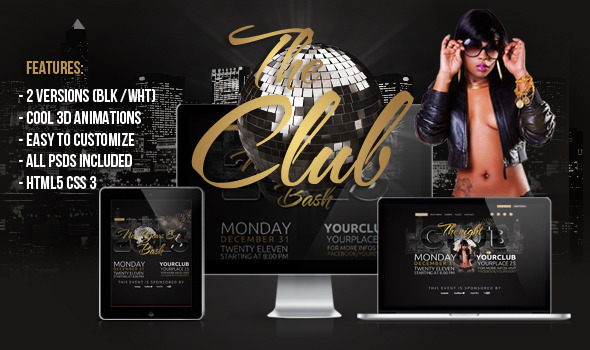
The Club 3D HTML Template Entertainment is a static HTML5 and CSS3 template for club nights, DJ sets, parties and event invitation pages, sold on ThemeForest for $16. It presents event details through animated 3D scene transitions instead of a conventional scrolling page, and ships with a dark night-club version, a light version, editable Photoshop files and a PHP contact form. It suits promoters, designers and freelancers who need a single self-contained promo page for a dated event and are comfortable editing raw markup.
What The Club 3D HTML Template Entertainment delivers
The centrepiece is the scene navigation. Rather than stacking sections vertically, the layout places content on planes in a shared three-dimensional space and moves between them with animated transitions, an approach associated with the jmpress.js library that the vendor lists among the template’s tags. The practical effect is a page that behaves like a short presentation: one scene for the headline act, one for the line-up, one for the venue and one for contact details.
Each scene can be addressed directly. Deep linking means every panel has its own URL fragment, so a promoter can post a link that opens on the ticket information or the line-up rather than at the opening animation. That matters on social media, where most visitors arrive from a single shared link and have little patience for clicking through an intro.
Two visual variants ship in the same download. The night-club version uses a dark palette suited to evening events; the white version swaps to a brighter treatment for daytime parties, brand launches or venues that need something less clubby. Because both share the same structure, switching between them is largely a stylesheet exercise rather than a rebuild.
Customisation support is unusually thorough for a template at this price. The Photoshop documents are organised with named, colour-coded folders and layers and use smart objects, so a designer can replace artwork without hunting through unnamed groups. Font download links are included in the documentation, and the vendor, createit-pl, publishes the template under the Template Rockers name with a how-to file aimed at non-developers.
The technical layer is straightforward: HTML5 markup, CSS3 styling, a fallback mode for browsers that do not support CSS3, and a contact form that sends mail through SMTP, including Gmail, on a host that runs PHP. The vendor describes the markup as SEO friendly, which in practice means the text content sits in the page rather than being injected by script.
Where The Club 3D HTML Template Entertainment fits — and where it does not
The template is a good match for one-off, date-specific promotions: a club night, a residency launch, a festival afterparty, an album release event, a venue’s New Year page or a private party invitation. Invitation pages benefit most, because the 3D transitions give a short sequence of details — date, address, dress code, RSVP — a sense of occasion that a plain one-page layout cannot match.
It also works as a venue microsite or a promotional screen. The legacy mode for non-CSS3 browsers is dated by modern standards but still relevant for older in-store screens, kiosks and tablets used as digital signage, where the browser is rarely updated.
It is the wrong choice for anything that changes often or grows. An events venue running a rolling calendar of weekly listings will be editing HTML every week, and there is no content management system, no event database, no ticketing integration and no blog. Teams without a coder should look at a WordPress entertainment theme or a hosted event page service instead. Projects with strict accessibility requirements should also be cautious: animated 3D transitions, keyboard focus behaviour and reduced-motion preferences are not described anywhere in the listing.
Setting up an entertainment template built on 3D scenes
The prerequisites are modest but real: a text editor, a web host reachable by FTP or a file manager, and a mailbox with SMTP details if the contact form is needed. Photoshop is required only for deeper visual changes to the artwork. The vendor’s documentation covers the common questions and links to the fonts used, though font licensing is not stated.
The workflow is to download the archive, read the how-to file, choose the night or white variant, then replace text, images and links in the markup. Colour changes sit in the stylesheet. The folder is then uploaded to the host and the contact form pointed at a working SMTP account. Expect one to three hours for a text-and-image swap by someone who knows basic HTML, and a day or two if a designer reworks the