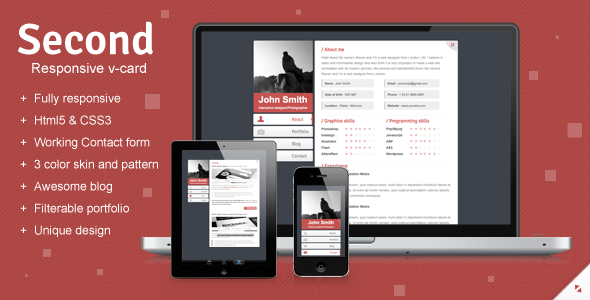
A static HTML5 and CSS3 template for a one-page virtual business card, Second is sold on ThemeForest by mutationthemes for $19. ThemeForest files it in the personal category, so it circulates under the name Second Responsive V-card Template personal, and its purpose is to put an introduction, a filterable portfolio, a short blog and contact details onto a single responsive site. It suits freelancers, contractors and job seekers who want a self-hosted introduction page and are comfortable editing HTML and CSS by hand.
What the Second Responsive V-card Template personal build actually does
The product is a small set of hand-written files rather than a theme that plugs into an existing platform. Everything a visitor sees comes from HTML markup, a few stylesheets and a jQuery script, so the finished site can be uploaded to ordinary shared hosting without a database or a content management system. That shapes every capability below: the template is quick to deploy but it does not manage content for its owner.
A single page that adapts across screen sizes
The layout is responsive, meaning the columns and type resize themselves for phones, tablets and desktops from the same files. For a personal card this matters because most first visits come from a link shared on a phone. The vendor does not publish the breakpoints or describe how the portfolio filter behaves on narrow screens, so the mobile view is worth checking in a browser before committing.
A filterable portfolio backed by a small blog
Work samples sit in a portfolio grid with filter buttons that show and hide items by category, which lets a freelancer separate, for example, branding work from web work without building separate pages. A blog section sits alongside it, complete with a comments area for each post. The blog is static markup, so publishing a new entry means duplicating a file and writing the HTML, and comments require a third-party service or a backend the buyer supplies. The vendor does not say how comments are stored.
Colour skins, background patterns and bundled design files
Three colour schemes are included — red, orange and green — each paired with three background patterns, giving nine quick visual combinations before any custom work begins. Because the styling lives almost entirely in CSS, swapping a brand colour is usually a find-and-replace across one or two files. A layered PSD of the design is bundled, which helps a designer rebuild graphics or export matching images, and an icon set ships with the template, though the listing does not identify which set.
Contact block with a map, validation and a working mail handler
The contact section pairs a form with a Google map showing a live location. The map coordinates are edited inside the JavaScript file, and the form includes client-side validation plus a PHP mail handler in the download, so it can send messages once the files are on a PHP-enabled server. Two caveats belong here rather than in a footnote: the vendor states no spam protection, and Google’s mapping terms have changed substantially since this code was written, so the map embed may need replacing with a current API key set-up.
Where the Second Responsive V-card Template personal package fits, and where it does not
The obvious buyer is an individual who needs a credible one-page presence and already has a domain and hosting: a freelance designer, a developer between contracts, a photographer, a consultant, or someone applying for work who wants a CV-style page with a portfolio attached. It also works as a fast starting point for an agency building a holding page or a personal landing page for a client, because the whole thing can be rebranded in an afternoon and handed over as flat files.
It is also a reasonable choice for anyone deliberately avoiding a CMS — a buyer who wants no database, no plugin updates and no login page to secure. Static files of this size are cheap to host and hard to break.
It is the wrong choice in three situations. Anyone who publishes often, or who wants to edit text from a phone, will find hand-editing HTML punishing within weeks. Anyone without basic HTML and CSS skills will be stuck on the first content swap. And any project with a current accessibility requirement, a strict security review or a need for long-term maintenance should look elsewhere: the codebase is old, and nothing in the listing suggests remediation for either issue.
Setting the product up in practice
Setup is short but entirely manual. The download is a folder of HTML pages, CSS files, a JavaScript file or two, images, the PSD and the PHP mail handler. The practical sequence is to unzip it, open the main HTML file in a code editor, replace the placeholder name, biography and social links, swap the images for real work samples, adjust the colour variables in the stylesheet, edit the map coordinates in the JavaScript file and configure the recipient address in send.php. Then the folder goes up by FTP or a host’s file manager.
The prerequisites are a text editor, access to a web server and, for the contact form, a host running PHP with mail sending enabled. No build tools, package manager or database are involved. Rebranding colours and text typically takes a couple of hours; a full content pass with portfolio images and a first blog post is closer to half a day for someone fluent in HTML. Buyers with no markup experience should budget considerably longer, since the vendor advertises no written documentation and support runs only through the author’s ThemeForest profile contact form.
Strengths and limitations
Strengths
- Self-contained static files: no database, no CMS install and no dependency stack beyond jQuery, so deployment to cheap hosting is trivial.
- Comments in the HTML, CSS and JavaScript are described as organised per section, which shortens the learning curve for anyone inheriting the files.
- The filterable portfolio plus working form and map is a lot of function for a $19 one-off licence, with no subscription attached.
- Colour skins and background patterns let a buyer produce a distinct-looking page without design work.
- The bundled PSD covers the full design, which is useful for matching new graphics to the original look.</li